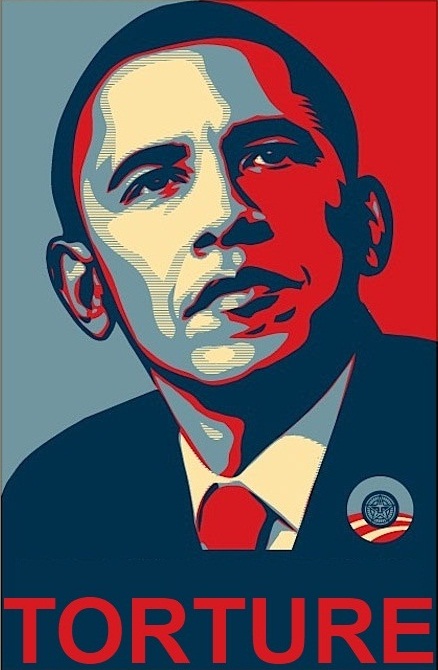
 ARREST OBAMA ON IRISH SOIL FOR TORTURE RELATED CRIMES
This campaign and petition is for the arrest and prosecution of Barack Obama pursuant to international law on the prevention of torture and cruel and inhumane treatment of human beings, during his state visit to Ireland on May 22nd. Visit the site here.
Basic goals and principles
From the petition page:We the undersigned, wish to express our support for the following statements: That, pursuant to a universal respect for human rights, and pursuant to the written law in the U.N Convention Against Torture and other international humanitarian treaties, torture, in any form, or its enablement, or the failure to prevent it or prosecute those responsible, is one of the worst crimes possible, and anathema to the values of our political order. That the wrongness of torture is amplified, and not lessened, by power and influence, and that pragmatic interests must not intervene in the rightful prosecution of those responsible for torture, however inconvenient that may be politically. That Barack Obama has now successfully assumed responsibility for the failure to prosecute torture, and that he is responsible, by omission, for the failure to prevent torture occurring under his own administration, and that this is illegal by international law. That Ireland’s obligations under international and domestic law are clear, and that we must prosecute torturers whenever it is possible to do so. That Barack Obama should be arrested when he sets foot on Irish soil, and made to face the consequences of his acts and of his failures to act.

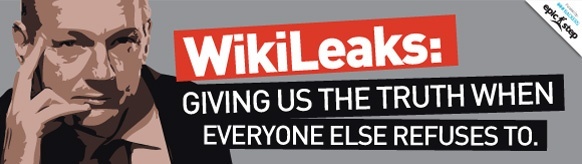
If this campaign does not reach $5,200 by 15 Apr 08:32 UTC, no credit cards will be charged.
UPDATE: Great job guys! With your support we have been able to fund one WikiLeaks billboard in Los Angeles and hope to fund more. This particular campaign is to fund a billboard in Chicago to further spread the WikiLeaks cause throughout the nation.
It is my sincere hope that everyone who believes in freedom of speech and transparency in government will take action by supporting this billboard campaign. Our government is treading in dangerous waters on this issue. We need to show our elected officials that we defend WikiLeaks, and demand adherence to the 1st Amendment and transparency in government. I stand behind WikiLeaks. Many Americans do. And though we all love our country, we want the facts and deserve the truth.
Our billboard will demand attention and entice news outlets to cover it. It will compel our elected officials to take notice, as we loudly express our support for WikiLeaks. We have a tremendous opportunity here. We can actually make our voices heard. It's up to us to spread this message.
I am extremely passionate about this campaign, but know that with the help of my fellow Epic Steppers, we can make it even better. I came up with this message: "In a time of universal deceit - telling the truth is a revolutionary act! - George Orwell." While I like this message, I think there could be a better one out there. So, I'd like to ask all you amazing designers and writers out there to come up with witty messages and creative designs. We need to have the best options possible to choose from in order to make our billboard really stand out and capture the hearts, minds, and news cameras this cause so desperately needs.
 End the punitive detention of Bradley Manning
Take Action On This Issue
Amnesty International is concerned that the conditions inflicted on Bradley Manning, the soldier accused of leaking information to Wikileaks, are unnecessarily severe and amount to inhumane treatment by the US authorities. Bradley Manning has not been convicted of any offence, but military authorities appear to be using all available means to punish him while in detention. The conditions under which Bradley Manning is held appear to breach the USA’s human rights obligations. Urge the Secretary of Defense to review the conditions under which Bradley Manning is confined and take effective measures to ensure that he is no longer held in 23-hour cellular confinement or subjected to other undue restrictions.
Message Recipients
Robert M. Gates (Republican), Barack Obama (Democrat) - President
Customize Your Letter (optional)
Subject Line:
Dear [Recepient's Name],
I am writing to urge you to review the conditions under which Private First Class (PFC) Bradley Manning is confined at the Quantico naval brig and take effective measures to ensure that he is no longer held in 23 hour cellular confinement or subjected to other undue restrictions.
Sign the Open Letter to the United States Government, Demand that they Stop Prosecution of Assange and WikiLeaks

Sign RevolutionTruth's open letter in defense of WikiLeaks and Julian Assange. Let the US Government know the world is watching, and we don't approve. Go here.
Open Letter to the United States Government Regarding WikiLeaks, Julian Assange and the Fundamental Tenets of Democracy and Open Societies.
To President Obama, US Senators and Congressmen and women, Attorney General Eric Holder, the Department of Justice, and all of those involved in the attempt to prosecute Julian Assange, founder of the nonprofit news organization WikiLeaks.org:
We are a diverse group of people from around the world who have come together for a common purpose: to defend WikiLeaks, to ask the United States to cease its attempts to manufacture a case against Julian Assange, and to defend democratic principles and our fundamental rights guaranteed therein. We are professionals, homemakers, activists, students, and others who believe that government derives its power from the consent of the governed, as stipulated in the Declaration of Independence, but that citizens can only give meaningful consent if they are fully informed about their government's actions. Nothing more violates American principles, which inspire both those of us who are and are not American citizens, than the idea that "government knows best" and has the right to deceive its own people.
"BLOW THE WHISTLE! on TWITTER"
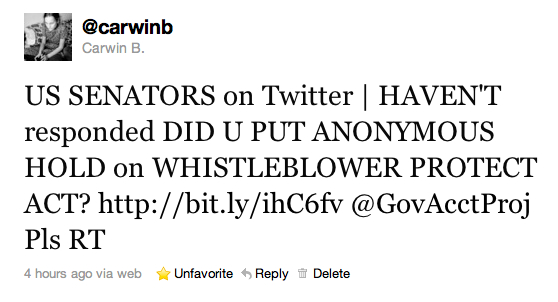
@Carwinb has compiled a list of Senators, who are on Twitter, and who have not yet responded to: "Did you place an anonymous hold on the Whistleblower Protection Act?" Now you can tweet them, and ask them yourself.
On December 22, 2010, the Whistleblower Protection Enhancement Act Bill S.372) was killed by an unknown United States Senator, who placed an anonymous hold on the bill (reported here on WL Central).
WNYC, On the Media and the Government Accountability Project have joined forces to uncover the identity of the mystery senator.
WNYC has posted a table, "containing the names, states, and contact information for the 87 [United States] Senators still serving that could have put the anonymous hold on this bill." You can find it here.
They are asking the American public to "call, write, [or] email their Senators and ask them 'did you kill this bill?'” Then, regardless of the Senator's reply, they request you email blowthewhistle@wnyc.org with an update.
Support Julian Assange Our Freedom Depends on it.
2011-01-19 Video Protest: This is a simple and direct open letter to the US government about WikiLeaks and Julian Assange spoken on video by people from around the world. We presently have approximately 12 countries and 35-50 people on board. The video will include your voices as part of a collective message as well as other relevant imagery and quotes that provide a full picture to help us meet our objective. The goal is for this video to be powerful, intelligent, moving and straightforward.
The objective of this project is two-fold. First, it is to interrupt the US government’s attempts to villainize and prosecute Julian Assange and bring down WikiLeaks. Second, it is to assist in shifting public opinion in the US by strategically highlighting the potential loss of key freedoms including free speech and a free press and the implications this could have on open societies everywhere. This video will be uploaded onto YouTube, highlighted on the www.support-julian-assange.com site, and loaded onto our new site (in construction) called www.nomino.org.
Open letter to be read
 2011-01-15: Dear President Obama,
I am outraged by the abuse of power by your government I have been witnessing against WikiLeaks and Julian Assange.
It is very clear to me that actions in those regards are NOT designed to protect the people, but to keep information about corruption and deceit by the government covered at all cost.
I ask you to stop all action against WikiLeaks and Julian Assange. I ask you to expose the corrupt individuals in your government and those who are protecting them. I ask for them to bear the consequences of their actions. Lastly, I ask you to assume personal responsibility for the humane and just treatment of Bradley Manning.
Sincerely,
Dagi Cueppers (on behalf of anybody who signs this petition)
Please join us in signing the petition and tweeting the message to Barack Obama here.
 Next: American official says PDP is not a party
"The United States does not consider the ruling Peoples’ Democratic Party a political party, a US diplomatic cable leaked to the whistleblowing site, Wikileaks, and made exclusively available to NEXT has shown.
Charge d’ affaires of the US embassy in Nigeria, Lisa Piascik, in a dispatch dated October 19, 2007, informed Washington that despite its labelling as a political party, the PDP did not meet “the common western understanding” of a political party."
The Guardian: WikiLeaks cable links defecting Yemeni general to smuggling rackets
"US diplomatic cables reveal powerful army chief behind moves to oust president is seen as unwelcome successor to Saleh.
The Yemeni general who has thrown his weight behind moves to oust President Ali Abdullah Saleh is a powerful and shadowy figure who has amassed a fortune in arms and fuel smuggling rackets, according to US diplomatic cables released by WikiLeaks."
(Image Credit: Dali Rău)
 Next: We got Obasanjo to anoint Yar'Adua, says Saraki
"Contrary to the belief that former President Olusegun Obasanjo personally hand-picked late President Umaru Yar'Adua as his successor, a United States diplomatic cable obtained by Wikileaks and made available exclusively to NEXT, has detailed how a group of governors led by Bukola Saraki, the Kwara State governor, worked behind the scene to pressure Mr. Obasanjo into anointing the former Katsina State governor as his replacement.
No other person than Mr. Saraki himself gave the account of the political intrigues that threw up the late president to a former US Consul General, Brian Browne."
Aftenposten: MP CRITICIZES JAPANESE NUCLEAR PLANS
"Lower House Diet Member Taro Kono voiced his strong opposition to the nuclear industry in Japan, especially nuclear reprocessing, based on issues of cost, safety, and security during a dinner with a visiting staffdel, Energy Attache and Economic Officer October 21. Kono also criticized the Japanese bureaucracy and power companies for continuing an outdated nuclear energy strategy, suppressing development of alternative energy, and keeping information from Diet members and the public. He also expressed dissatisfaction with the current election campaign law."
Aftenposten: CLIMATE CHANGE: EMISSION IMPOSSIBLE: NPP SHUTDOWN EXACERBATES JAPAN´S KYOTO TARGET BIND
Next: US view of Nigeria's most influential persons
Next: 'Vengeance is his': US official on Obasanjo
"Former President Olusegun Obasanjo has a penchant for “storied vindictiveness” and “proverbial vengefulness”, American embassy officials told their superiors in Washington. In a cable titled ‘Bayelsa governor’s arrest strikes fear in the hearts of his peers’ and sent to Washington on October 21, 2005, the consul general at the American embassy in Nigeria at the time, Brian Browne, described how governors of other southern states became jittery following the arrest of the former Bayelsa State governor. Mr. Alamieyeseigha was arrested in London in September 2005 on charges of money laundering. At the time of his arrest, about £1 million cash was found in his London home. He jumped bail in December 2005 but was impeached upon his return to Nigeria and prosecuted by the Economic and Financial Crimes Commission (EFCC) for corruption. Two years later, on July 26, 2007, Mr. Alamieyeseigha pleaded guilty to a six-count charge of corruption and was sentenced to two years in prison on each count. The consul general, in his cable, which was sent before the former governor’s escape from the UK, told his superiors that Mr. Alamieyeseigha’s arrest in the UK was not only due to corruption allegations, but also due to his friendship with former vice president, Atiku Abubakar, who was Mr. Obasanjo’s arch enemy at the time."
Next: Inside NDDC and EFCC
Next: Yar’Adua asked Ibori to turn himself in, says Saraki
"Disturbed by the waning bilateral relations between Nigeria and the US government over the perceived lack of vigour in the anti-corruption fight, late President Umaru Yar’Adua asked James Ibori, the corrupt former governor of Delta State, to turn himself in to the British Metropolitan Police.
According to a U.S. diplomatic cable, made available to NEXT, Bukola Saraki, Kwara State governor, a close friend of Mr. Ibori and confidant of Mr. Yar’Adua, said this in a chat with former US ambassador to Nigeria, Robin Sanders."
Next: ‘We blocked Obasanjo, Babangida’s candidates for PDP chair’
"The emergence of Vincent Ogbulafor as National Chairman of the People’s Democratic Party (PDP) in 2008 was a result of deft political manoeuvring and intense power play among three former Nigerian presidents which saw the camp of late President Umaru Yar’Adua triumphing, according to a leaked U.S. diplomatic cable made available to NEXT.
Bukola Saraki, the Kwara State governor, told former U.S ambassador, Robin Sanders, during a meeting on September 22, 2008 that he used his powerful position as the Chairman of the Nigeria Governors’ Forum to help Mr. Yar’Adua’s anointed candidate emerge victorious."
The Telegraph: US feared British 'sharia banks' would finance terrorist groups
"Britain's enthusiastic support for "sharia banking" raised concerns in Washington that the City of London could become a centre of terrorist funding, leaked documents show.
Financial reforms pushed through by the Labour government allowed Islamic banks to flourish in Britain, amassing assets valued at more than £12 billion."
The Telegraph: US feared British 'sharia banks' would finance terrorist groups
"Japan was warned more than two years ago by the international nuclear watchdog that its nuclear power plants were not capable of withstanding powerful earthquakes, leaked diplomatic cables reveal.
An official from the International Atomic Energy Agency (IAEA) said in December 2008 that safety rules were out of date and strong earthquakes would pose a "serious problem" for nuclear power stations."
La Jornada: EU rechaza que Josefina Reyes haya sido asesinada debido a su activismo (EU rejects that Josefina Reyes has been killed because of her activism)
"Señala en un cable que el homicidio es producto de "sus vínculos" con delincuentes. (It is pointed out in a cable that the murder is product of "ties" with criminals.)"
Read more (Spanish) Google Translate
La Jornada: Por "insistencia" de EU se relegó al Ejército de la lucha antinarco en Juárez (By "insistence" of EU was relegated the fighting anti-narco army in Juárez)
"Cables revelan la "colaboración" estadunidense para dejar al frente a la PF. (Cables reveal U.S. "collaboration" to give control to the Federal Police.)"
Read more (Spanish) Google Translate
La Jornada: PGR y SG pidieron ayuda a EU para enfocar la lucha en dos ciudades (SG [Secretary of Government] and PGR [General Police of the Republic] sought for help from U.S. to focus on the struggle of two cities)
"Calderón "se juega su reputación" en el combate al crimen organizado, afirmaron". (Calderón "is staking its reputation" in the fight against organized crime, they said.)
Read more (Spanish) Google Translate
El País: EE UU cree que Lugo carece de apoyos para gobernar Paraguay (The United States believes that Lugo lacks support to govern Paraguay)
"El presidente de Paraguay, Fernando Lugo, comenzó a gobernar en el año 2008 con serias turbulencias y maniobras desestabilizadoras de la oposición, que a los pocos meses de la investidura imputó al exobispo impericia, favoritismo, la promoción de la lucha de clases y le culpó por la inseguridad ciudadana y el estancamiento político. (The president of Paraguay, Fernando Lugo, began to rule in 2008 with serious disturbances and destabilizing maneuvers of the opposition, which a few months after the inauguration accused the ex-bishop of incompetence, favoritism, the promotion of fights between classes and blamed him about the insecurity and political stalemate.)"
Read more (Spanish) Google Translate
(Image Credit: Dali Rău)
Aftenposten: FRENCH TOTAL-LED CONSORTIUMS ACCEPT LOWER PRODUCTION SHARES IN LIBYA
"Libya´s National Oil Corporation (NOC) renegotiated the terms of its production sharing agreements with France´s Total and its partners in Libya (Germany´s Wintershall and Norway´s StatoilHydro), adjusting the existing stand-alone contracts to bring them into compliance with the Exploration and Production Sharing Agreement (EPSA) rubric. The renegotiation of Total´s contract is of a piece with the NOC´s effort to renegotiate existing contracts to increase the Libya´s share of crude oil production. An interesting corollary is that one of the affected fields is that from which Saif al-Islam al-Qadhafi, a son of Muammar al-Qadhafi, periodically obtains oil lifts, which he sells to finance his various activities. Depending on whether his lifts had been coming out of the NOC´s production share or Total´s (it´s not clear what the arrangement was), the renegotiated agreements could adversely impact his revenue stream."
La Jornada: En 2009, Pascual destapó la debilidad de AN y Calderón tras la elección intermedia (In 2009, Pascual uncovered the weakness of AN and Calderon after the election term)
"En cable diplomático, el embajador describió el entorno político Calderón, "abrumado e inseguro" sobre la vía a seguir, sostuvo "Cree que un repentino éxito" en seguridad dará impulso a su posición, dijo. (In a diplomatic cable, the ambassador described the Calderón's political environment, [who was] "overwhelmed and unsure" about the way forward; "he believes that an overnight success" in security will boost its position, he said.)"
Read more (Spanish) Google Translate
(Image Credit: Dali Rău)
Next: Govt paid N20m ransom to free Delta hostages
"The Nigerian government, through its secret police, fuelled kidnapping in the restive Niger Delta region by paying millions of naira in ransom to kidnappers, a leaked US diplomatic cable, made available to NEXT, has revealed.
The cable, dated February 6, 2007, and which punctured the claims by the government, and the Nigerian security agencies, that ransoms were never paid to kidnappers, detailed how the government funnelled N20 million through an official of the State Security Service (SSS) to militants to free two foreign hostages."
Next: CHEVRON NIGERIA SEEKS LONG-TERM SOLUTION TO DELTA UNREST
"Chevron Nigeria security consultant Hamish MacDonald shared concerns that a large amount of money was paid for the release of the Delta hostages and an industry of hostage-taking may be in the offing. Chevron has managed thus far to stay out of harm's way, but MacDonald feels the urgent need to expand internationally-supported, long-term development programs. He plans to discuss the matter privately with Delta State Governor Ibori. Chevron will be welcoming a new Managing Director, and, with his arrival, MacDonald expects Chevron to transition from an expansion mode to one of consolidation."
El País: "Ábrelo y di ahhhh: Sistema venezolano de salud" ("Open it up and say ahhhh: Venezuelan health system")
Next: Yar’Adua made me acting President, says Yayale
"As his health failed late president Umaru Yar’Adua illegally bypassed his vice president, Goodluck Jonathan, and handed presidential authority to Yayale Ahmed, the Secretary to the Government of the Federation.
This unconstitutional act has now come to light through US diplomatic cables leaked to Wikileaks and made available exclusively to NEXT."
Next: Buhari says speaker’s comments confirm his fears
"Two parties who went to court over the 2007 presidential elections, Atiku Abubakar and Muhammadu Buhari, yesterday reacted to comments credited to Speaker Dimeji Bankole that the late president, Musa Yar’Adua, bribed Supreme Court justices to swing the judgment in his favour. While Mr. Abubakar, the candidate of the opposition Action Congress in the election, maintained that the speaker of the House of Representatives’s comment had disgraced Nigeria, Mr. Buhari, the presidential candidate of the Congress for Progressive Change, said the revelation had vindicated his stand that the nation’s judiciary could not be trusted, and therefore needed a thorough overhaul."
Der Spiegel: EADS-Manager verspotteten Kollegen vor US-Diplomaten (EADS managers colleagues mocked U.S. diplomats)

Bradley Manning's inhumane treatment during his pretrial incarceration looks set to become a millstone around Obama's neck in his dealings with other countries.
Today, International Bradley Manning Support Day, marks also the announcement of a campaign to have the United States president arrested once he arrives on Irish soil, during a planned visit to the Western European democracy in May. The #ArrestObama #May22 campaign holds that Ireland has an obligation under international law to pursue and prosecute all those within its jurisdiction who carry out or authorize torture, or who permit torture to be carried out, or who obstruct bringing those who do so to justice.
The campaign makes the claim that Obama's failure to prosecute high-ranking Bush administration officials - as well as the cruel and inhumane treatment to which U.S. military whistleblower Bradley Manning is being subjected in the Marine brig in Quantico - constitutes ownership of responsibility for torture.
The campaign comes at an inconvenient moment for the new Fine Gael/Labour coalition government, elected mid-last-month in a landslide ousting of the previously dominant Fianna Fail party. The new government will be seeking to establish strong diplomatic ties with the United States, in the hopes that this will reap benefits in the face of Ireland's withering economic situation. In November, the last Irish government revealed that it had negotiated a deal with the International Monetary Fund, in response to the deepening crisis in the banking sector. Any matter that jeopardizes the precarious bargaining position of the tiny European state will likely frustrate the fledgling government.
WL Central will be covering the Bradley Manning protests in Quantico this weekend. Currently, protesters were warned to leave the site, 118 stayed past the final warning, arrests have begun. FireDogLake reports that the director of operations at Quantico Marine Base issued a “threat advisory” regarding the protests this weekend.
Details of the protests and how to get to one here. For more information regarding Bradley Manning and supporting him, please go here.


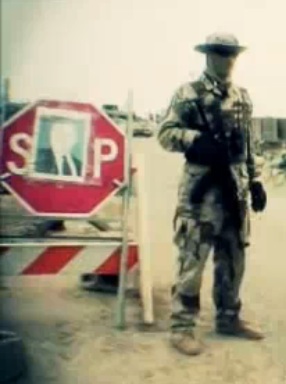 This date, March 19, 2011, marks the beginning of the ninth year of the US war in Iraq. The war, which began in 2003 with a bombing campaign of “shock and awe," has for years been more of an occupation than a war. Despite the fact that many believe the war is over (especially Americans), the US still has 47,000 troops in Iraq and, despite a 2011 withdrawal date, will likely continue to have tens of thousands of soldiers based in Iraq for years to come.
The past year has seen the world learn a great deal about the US war and occupation of Iraq. With the WikiLeaks release of US State Cables, the Iraq War Logs, and a “Collateral Murder” video showing US soldiers firing on journalists and innocent civilians from an Apache helicopter, the criminal nature of the war and occupation has become more evident. To mark the end of eight years of US troops in Iraq and the beginning of a ninth year, it is worth noting the many revelations on Iraq that have become known thanks to WikiLeaks.
On October 22, 2010, 390,000 field reports, which became known as the Iraq War Logs, showed the regular use of abuse, brutality and torture used on Iraqis by Iraqi Police and Iraqi Security Forces. The logs revealed, despite US claims, a tracking of civilian deaths had been going on, and, in fact, 66,000 civilian deaths (15,000 which were previously unknown) had occurred.
On 10th March 2011 Australian Prime Minister Julia Gillard made a speech to the US Congress. It was notable for one reason, the US media appeared barely to report it—Google searches show Australian entries page after page—and perhaps that’s because the US media market for show ponies, seals and canines performing obsequiously for an audience is already saturated.
Crafted for a US audience it was as Hugh White (Australian National University professor and a former senior Defence Department official) said: a piece of policy-free puff…I suppose she wanted the Americans to like her, but she decided not to say anything serious to them.
Our leaders never say much that is seriously an assertive, independent point of view to the USA. This is of course as befits a thoroughly one sided relationship characterised by ultra obsequiousness by an almost endless line of Australian prime ministers from Robert Menzies who begged the US to join in the Vietnam war; Harold Holt’s—all the way with LBJ and more lately John Howard who jumped on the Bush orchestrated litany of lies bandwagon, otherwise known as the second Iraq war (and absurdly incorporating a war on an abstract noun--terrorism) as if we somehow owed an eternal debt--which can never be repaid--as a satrapy of the USA and our prime ministers are the satraps. Or as liberal party Senator Brandis, leaker of the ‘Ratty’ label might have said in the case of John Howard, a ratsap.

This work is licensed under a Creative Commons Attribution-NonCommercial-NoDerivs 3.0 Unported License.
Theme by Danetsoft and Danang Probo Sayekti inspired by Maksimer

