Last Thursday, human rights and Julian Assange lawyer Jennifer Robinson was held up on her flight from London to Sydney for security reasons. Over the years, journalists have been interrogated and detained at borders, often for purely political reasons. This incident was unprecedented with a lawyer now facing similar treatment.
Robinson was told that she is on an "inhibited" list of mysterious origin and that the Australian High Commission in London needed to be contacted before her departure. At some point, she was given the green light to board without that call being made and was able to get to her destination. When pressed, Australian Attorney General Roxon showed concern about the incident. She said that "this is not the result of any action taken by the Australian Government. We believe [Robinson], as an Australian who is not subject to any criminal charges or allegations, should be free to travel in and out of Australia."
The Guardian reported that "The Australian high commission in London has no record of a call being received from UK authorities concerning her travel". Virgin Atlantic, the airline that stopped Robinson, deferred responsibility to security services, while the UK Border Agency and DFAT each deny involvement.
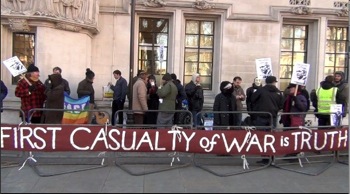 During the second and final day of the U.K. Supreme Court's hearings on Julian Assange's extradition, Matrix Chambers attorney Clare Montgomery offered her rebuttal to arguments made yesterday by Assange's counsel. (Dinah Rose is representing Assange in his fight against extradition to Sweden for questioning on sex crime allegations.)
The week's proceedings have highlighted disparities of law among EU countries and the legal challenges involved in reconciling these conflicts. Assange's case may test the extent to which EU nations can maintain their legal autonomy under the rubric of a unified European system. It may also raise the question: to what degree will EU states have to harmonize their conflicting legal regimes in order to avoid this sort of continued legal wrangling in the future?
Montgomery presented Sweden's case against Assange for about four hours, during which time she appeared to reject EU-wide legal standardization -- essentially arguing that respecting state sovereignty requires preserving the status quo. If it agreed with Montgomery's position, the Court would have to accept significant differences among EU nations in implementing EU-wide legal standards. By contrast, Assange's legal team largely took the position that, while allowing for some variation and inconsistency, the Court should mandate certain universal principles in the extradition process, because of the seriousness of the potential risk that extradition may pose to individual rights.
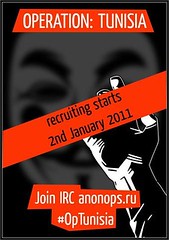 2011 actually started on December 17, 2010 although none of us knew it at the time. On that provident day a fruit peddler in Tunisia decided that he was mad as hell and not going to take it anymore. In the year since then, his sentiment has been echoed by millions around the globe in the greatest show of people power that we have seen in more than 40 years.
Mohamed Bouazizi, who could find no other work and took to selling fruits and vegetables, had grown tired of the police harassment. When his complaints to city hall went unanswered, he doused himself with gasoline and lit a fire that is blazing still.
Had his act of defiance happened in any earlier epoch, it most likely would have gained little notice outside of word of mouth, but we now live in an age when word of mouth spans the globe. We have the technology, even in North Africa.
So news of his defiance spread throughout Tunisia in a flash and the people rose up to demand justice from the government. Then, via WikiLeaks, the Tunisian people found out just how corrupt their government really was and started to demand an end to the 20 year rule of Ben Ali. When they did this, their struggle took a revolutionary turn.
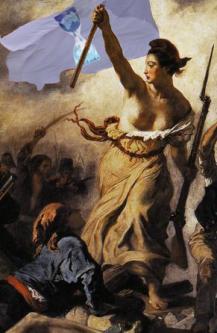
In mid-September, Occupy Wall Street began in downtown Manhattan. For over a century, Wall Street has represented wealth and political power. Now, the streets of the financial district that only months before gleamed with the facade of enduring capitalism were flooded by ‘occupiers’, revealing the truth behind the broken promises of equal opportunity and corrupt excess of corporate America.
Here were people from all walks of life, foreclosed and unemployed, students with debts and those who struggle with a pay-or-die medical system. As the people marched with a mixture of jubilation and outrage against the plutocratic takeover of power, the glorified spectacle of the American Dream crumbled in the background.
No one can deny that the Occupy Movement struck a chord with the rank and file of America as it quickly spread nationwide. A couple months in, students at UC Berkeley pitched tents on the Mario Savio steps in front of Sproul Hall. When UC police came to dismantle the tents, students linked arms, standing up for their right to freely express themselves. Facing them, armed police violently jabbed them with sticks. This contrast became obvious to the world immediately as the YouTube video of the police attack went viral.
Council of Europe Human Rights Commissioner Thomas Hammarberg stated in a recent interview with Polish public TV that he has evidence on a CIA prison on Polish soil, and that he is positive that this material is also in the possession of the Polish prosecutor investigating the case.
He also said that he knew who was held in this prison. Insofar, publicly known evidence only proved that CIA planes landed in Szymany. All other conclusions were based on circumstantial evidence. As a source for this information Hammarberg quoted leaks from various sources, including the CIA itself, and official documents.
Hammarberg has already briefed Polish MFA Radosław Sikorski about his findings, and expects the investigation to proceed very soon.
Currently, there are two separate legal cases underway, an investigation in Poland, and a complaint at the European Court of Human Rights, amongst others for a failure to investigate. WL Central recently reported on a newly released Wikileaks document, which proves a complicity between the US and Poland to cover up the issue of the CIA prison. This document was strangely overlooked by various media partners who had access to this material for several months.
For our previous coverage please see this link.

Wikileaks just published the following statement:
"Recent statement by the New York based CPJ is misleading.
The Ethiopian journalist, Argaw Ashine, mentioned by the CPJ in its press release today, is not detailed by WikiLeaks cables as a US embassy informant. No journalistic source is named or identified in the cable. Rather, Mr. Ashine is mentioned, in passing, in relation to events in 2005 and 2006. Neither was Mr. Ashine named by the CPJ in a list of journalistic related redactions processed by us. While, it is outrageous for a journalist to feel the need to leave their country for a period, neither is it good for the CPJ to distort the facts for marketing purposes. Extraordinarily, the CPJ reserves more words for WikiLeaks, who has no influence on the situation, than it does for the Ethiopian government, or its military and intelligence backer, Washington.
The Guardian newspaper disclosed the Cablegate decryption password, and nearly a year of careful redactions, in a violation of our Memorandum of Understanding. The Guardian editor responsible has stated (to the Economist), that he "regrets" the error. Such issues are part and parcel of working with the mainstream press, which must be able to decrypt our material in order to read it. Understandably, we are reconsidering how we deal with such institutions, if at all.
In the last two weeks WikiLeaks has released details on the slayings of several journalists by U.S. forces. The CPJ has covered none of the new detail on these killings, or the dozens of other attacks on the press we have recently exposed in the last month. Nor has it spoken about the hundred raids or arrests on our supporters, or the unprecedented extrajudicial economic warfare levied against us. We hope that this is an oversight and not a reflection of CPJ's U.S. centric funding arrangements.
The broader issues are detailed in New Scientist:
In his first interview since being released from jail, Rudolf Elmer stated to India Today that:
- the investigation against him is still ongoing, and that he could not make any detailed statements because he would be arrested again.
- the CDs he handed over to Julian Assange in the Frontline Club were empty. He also said that it was only a symbolic handover, because it was a public place, and because the police could have intervened. He also said that Assange would not have come, had there not been information.
- that he would not have been released from prison had any data been published.
- that he cannot answer whether any Indian names are on a list he allegedly gave to Assange, as the investigation against him was still ongoing.
- it is possible to keep money out of reach of tax authorities. He also describes how this could be done, in hypothesis.
- that he cannot comment on whether any Indian cricket players have Swiss bank accounts because his investigation is still ongoing.
- that private investigators put pressure on him and his family, including his six year old daughter.
- that he filed a complaint at the European Court of Human Rights.
- that he will appear in court in November.
- that Assange protected him and his family. This statement was made in reply to a question whether there was a deal between Assange and the courts that Assange will not publish the data.
WL Central cannot verify these claims. The above is merely a summary of some key points in this interview. For our previous coverage of the topic please see this link.
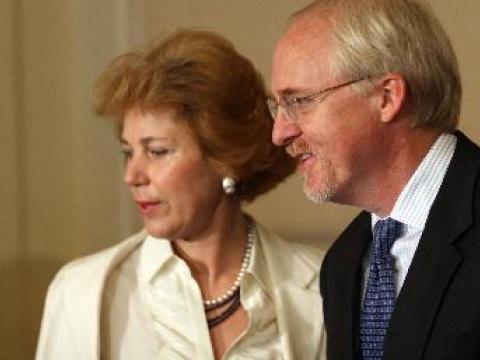
A secret diplomatic cable [08SOFIA185], released by Wikileaks and dated March 27, 2008, reveals that Bulgarian Ambassador in Washington, DC, now serving a second term there, Elena Poptodorova and then Deputy Defense Minister, Sonya Yankulova, have informed American Ambassador in Sofia John Beyrle about plans to increase the Bulgarian contingent in Kandahar by fifty rangers, months before the official decision of the Bulgarian cabinet.
The cable is also shading light on the steady pressure exerted by US officials on the Government of Bulgaria to expand its Afghan contribution with new contingent.
In two separate meetings, Poptorova and Yankulova have stressed to Beyrle that this had been sensitive information while the diplomat wrote in the cable, classified as secret, that both ladies must be under a strictly protect status.
"Bulgaria is set to announce a decision to deploy an additional 50 soldiers to take over the Entry Control Point Number Four mission at Kandahar Airfield. It is keeping this decision under tight wraps for now. We expect the formal decision will be made just before the NATO Summit, and the announcement itself probably in Bucharest by the Prime Minister. Both Ambassador Poptodorova in Washington and Deputy Defense Minister Yankulova (strictly protect) have foreshadowed this outcome and the sensitivity of the decision and announcement timing," Beyrle informs in his report.
"While a formal decision is still days off, and there is still some scope for a mis-step, we would be surprised if Bulgaria does not come through," the Ambassador concludes.
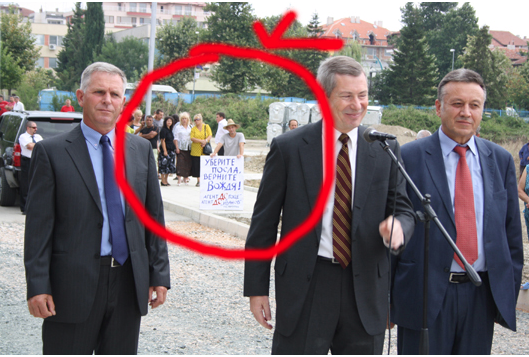
Your Excellency,
One year ago you were opening a bridge connecting the Roma district in Tsarevo with the rest of the Black Sea town.
You were standing among the audience next to the town’s Mayor, Petko Arnaudov, and Regional Governor, Konstantin Grebenarov. Both are former members of a party, declared criminal by current Bulgarian legislation – the Bulgarian Communist Party, and are agents of the macabre Communist State Security, DS.
I stood behind you with a large portrait of Lenin. The following message was written on its back: “Уберите посла, верните Вождя. Агент ДС “Гоце” и Агент ДС “Иванов” град Мичурин” (In Russian, meaning “Take away the Ambassador, bring back the Leader. DS Agent Gotse (which is the alias of current Bulgarian President, Georgi Parvanov, as Communist State Security Agent) and DS Agent, Ivanov (which is the alias of the Mayor Petko Arnaudov), town of Michurin).
I was hoping that you, personally, and the attending media would notice the board and ask me why I was standing there and what this curious installation meant. But the first one to notice me, even before you, was the Mayor, who became outraged and said: “Who is the Gipsy with Lenin?”
Police arrived and took me away to the precinct where I received a citation for violating public order, even though I did not violate anything. They also confiscated my sign. I suppose meanwhile Agent Ivanov (Petko Arnaudov) took you to an official dinner where you proposed toasts for the integration of Roma.
Minutes before the policemen took me away, I saw you hugging and kissing Agent Ivanov. It was truly touching. The Roma applauded, the municipal female workers were taking deep breaths and were moved.
The Guardian has now responded to Wikileaks' accusations. They state that they were told that the password was only temporary, and that the server from which the file was downloaded was only live for a few hours.
They also claim that the file was available on BitTorrent at some point.
This statement raises a valid point, namely how the files came to be posted on the web. Had their present location been controlled by Wikileaks, the file would have been removed by now. According to Spiegel (original), the file was posted online by "supporters", after it was handed back by Daniel Domscheit-Berg, who had seized the Wikileaks servers. According to Heise, he was asked to return the old Wikileaks website, which he did. The file in question must have been transferred along with it.
Please see our previous coverage for more information.
Wikileaks just posted this editorial:
WIKILEAKS EDITORIAL - Guardian disclosure
Wed Aug 31 23:44:00 2011 GMT
A Guardian journalist has negligently disclosed top secret WikiLeaks’ decryption passwords to hundreds of thousands of unredacted unpublished US diplomatic cables.
Knowledge of the Guardian disclosure has spread privately over several months but reached critical mass last week. The unpublished WikiLeaks’ material includes over 100,000 classified unredacted cables that were being analyzed, in parts, by over 50 media and human rights organizations from around the world.
For the past month WikiLeaks has been in the unenviable position of not being able to comment on what has happened, since to do so would be to draw attention to the decryption passwords in the Guardian book. Now that the connection has been made public by others we can explain what happened and what we intend to do.
WikiLeaks has commenced pre-litigation action against the Guardian and an individual in Germany who was distributing the Guardian passwords for personal gain.
Over the past nine months, WikiLeaks has been carefully releasing US diplomatic cables according to a carefully laid out plan to stimulate profound changes. A number of human rights groups, including Amnesty International, believe that the co-ordinated release of the cables contributed to triggering the Arab Spring. By forming partnerships with over 90 other media and human rights organizations WikiLeaks has been laying the ground for positive political change all over the world.
It finally happened. An old cablegate file was detected on the internet, and it could be decrypted with a password that was published by a Guardian journalist. The file is not in an obvious location, and it may be doubted that anyone would have ever found it, along with the matching password, had it not been for Der Freitag publishing an article on the matter, which was then followed up by several other news outlets. Der Freitag is a media partner of Openleaks and has strong ties with the Guardian.
WL Central had guessed the source of the password early on but decided not to publish.
Wikileaks responded with the following statement:
"Statement on the betrayal of WikiLeaks passwords by the Guardian.
GMT Wed Aug 31 22:27:48 2011 GMT
A Guardian journalist has, in a previously undetected act of gross negligence or malice, and in violation a signed security agreement with the Guardian's editor-in-chief Alan Rusbridger, disclosed top secret decryption passwords to the entire, unredacted, WikiLeaks Cablegate archive. We have already spoken to the State Department and commenced pre-litigation action. We will issue a formal statement in due course.
WIKILEAKS"
For our previous coverage of the topic please see this link.
In the light of the recent press statements by Openleaks spokesperson Daniel Domscheit-Berg we decided to have a look at some older coverage, in particular his Spiegel interview from the 27th of September 2010. It appeared soon after he had left Wikileaks, and it was also translated into English.
The first question of the Spiegel reporters concerned the state of the Wikileaks IT infrastructure. Asked why the Wikileaks e mail system was down, Domscheit-Berg answered:
"Es gibt technische Probleme und niemanden, der sich darum kümmert. WikiLeaks steckt in einer Phase, in der sich das Projekt verändern müsste. Wir sind in den letzten Monaten wahnsinnig schnell gewachsen und müssten uns dringend in allen Bereichen professionalisieren und transparenter werden. Diese Entwicklung wird intern blockiert."
"There are technical problems and no one to take care of them. WikiLeaks is stuck in a phase in which the project has to change itself. We grew insanely fast in recent months and we urgently need to become more professional and transparent in all areas. This development is being blocked internally."
He does not mention that it was him and an associate who took the servers offline, as he now admitted. Rather, he makes it appear that this was a general structural problem.
Another very interesting fact is that he admits to having coordinated the finances of Wikileaks. Thus, he acknowledges that he knew about the funds available via the Wau Holland Foundation. This makes it very difficult to comprehend, why he would have paid servers privately, as he has now claimed.
According to Spiegel, a complete version of Cablegate has been available on the internet. This is their account of the story:
Julian Assange uploaded an encrypted archive containing Cablegate to the Wikileaks webserver, to share it with an associate, to whom he also gave the password. When Daniel Domscheit-Berg left the organization together with the Architect, he took the content of the webserver with him. He eventually returned some of the data a few weeks later.
At this point the narrative is not entirely clear. Spiegel goes on to say that supporters published the data on the web, along with the encrypted Cablegate file. Simultaneously, the associate published the password. The vulnerability remained unnoticed, until Openleaks staff pointed it out.
WL Central could not verify these claims. It is however clear that the vulnerability was first pointed out by Der Freitag, a media partner of Openleaks.
In a variety of aspects, this is a very strange story. First, it seems odd to use the main Wikileaks website for transfer of sensitive data. This could easily have been done by other means, in a more secure way. Next, one is left wondering how anyone could have overlooked a massive archive in a hidden subdirectory when setting up a website. Most striking is the fact that someone would be irresponsible enough to publish a password.
Openleaks staff must have known about this vulnerability for some time, but did not bother to reveal it to those in charge of the website, nor did their media partners. It is certainly right to report about it, but it should be done in a responsible manner, making sure the file is removed before this information is publicly available.
From Novinite.com
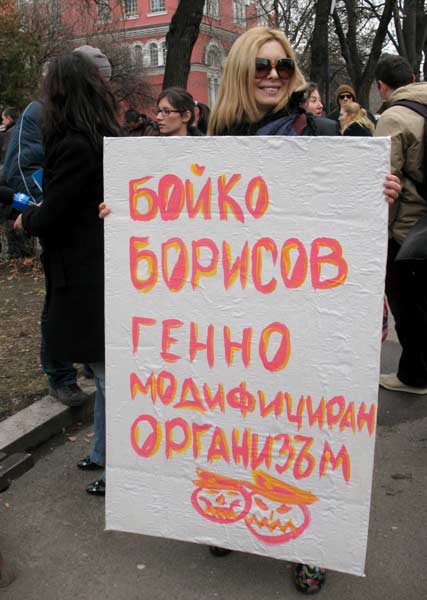
Bulgaria's legislation on Genetically Modified Organisms (GMO) has been carefully followed by the US Embassy in Sofia.
The information comes from several US diplomatic cables, (one by current US Ambassador in Sofia, James Warlick), which were released by WikiLeaks and their Bulgarian partner, the site for investigative journalism Bivol.bg.
According to the cables, GMO supporters in Bulgaria are actively backed and financed by the American Embassy, as Bivol writes.
In a cable, sent in 2006, Charge d'Affaires, Alex Karagiannis, informs the US Department of State that the main obstacle for the passing of more liberal GMO legislation has been opposition coming from the President of the Bulgarian Academy of Science (BAS), Ivan Juchnovski.
In the first extensive media interview with Austrian public broadcaster ORF Daniel Domscheit-Berg appears as contradictory as ever. He admits to having deleted the keys to the documents -- which according to him were deleted by an unnamed other person or persons -- out of concern for source protection, even though he had offers from "10 to 15 individuals or organizations" who offered to take care of the data. When challenged, he added that he wanted to be on the safe side, as he could not be sure whether these potential recipients would make mistakes and expose a source.
At the same time, he reiterated that the documents he destroyed did not contain any significant information, while maintaining that only 80 to 90% of said documents were junk -- presumably. He also stated that he had not had the documents themselves in his possession, but only the keys.
Even though he does not specify who offered him assistance in handling the documents, it is safe to assume that for instance his media partners would have had an interest in surveying the material, as would have other news outlets who are perfectly capable of handling sensitive content. It would not have been difficult to make contact and find responsible journalists for this task.
Simultaneously, he promotes his own submission platform Openleaks, which would, once established, pass leaked documents on to media partners. Here, Domscheit-Berg does not seem to have any concerns about source protection and potential mistakes.
Wikileaks releases 55 thousand cables from the U.S. embassies in Iran, Afghanistan, Israel, Russia, and Venezuela, among others. Through their official channels they asked for citizen participation in analyzing them. They also asked that they post their finds by sending them to @wikileaks on Twitter under the hashtag #wlfind. You can take a look at the cables yourself by visiting this link: http://wikileaks.org/tag/TU_0.html or http://www.cablegatesearch.net/search.php.
As a consequence of this release, Wikileak's Californian DNS hoster, Dynadot, "has received a PATRIOT act production order for information on Julian Assange", according to their website. It also mentioned that it had been complied and that "the production order seeks all available information on Julian Assange and WikiLeaks, for the US grand jury in Alexandria, Washington."
Five days after Daniel Domscheit-Berg claimed to have shredded data he "seized" from Wikileaks, he announced via Heise that he only destroyed the keys to the data, and was working on a report on the matter.
In the meantime, Wikileaks tweeted that these documents contained amongst others 5GB data from the Bank of America, internals of neo-nazi organizations, a copy of the US no fly list, 60,000 e mails from German far right party NDP, US intercept arrangements and videos of a major US atrocity in Afghanistan.
Wikileaks also reacted with an official statement, suggesting that Domscheit-Berg has contacts to US law enforcement and the secret service. Anke Domscheit-Berg, his wife, has denied having any such contacts.
According to N-TV Domscheit-Berg today confirmed that he uses the Wikileaks submission software, which he took along with the leaked documents, for his own Openleaks project.
The recent clash between Daniel Domscheit-Berg and the Chaos Computer Club brought an important matter back into the focus of the mainstream press, a larger number of leaked documents, which Domscheit-Berg took with him after he left Wikileaks almost one year ago.
Andy Müller Maguhn, a board member of the CCC had been trying to mediate between Domscheit-Berg and Wikileaks ever since. In a recent Spiegel interview, he says that Domscheit-Berg recently told him he would have to survey the documents one by one before returning them to Wikileaks, which implies he has these documents in his possession.
This is very much in accordance with what Domscheit-Berg said in his own book. When an excerpt of the English translation of his work was leaked to Cryptome, he insisted that they contained translation errors. He later posted the passage in question on a German news site in the original language.
This is the crucial sentence:
"Wir warten bis heute darauf, dass Julian die Sicherheit wiederherstellt, damit wir ihm auch das Material zurückgeben können, das auf der Submission-Plattform lag."
It translates to:
"To this day, we are waiting for Julian to restore security, so that we can return the material to him, which was on the submission platform." [Translated by icon]
Recently, however, and a few days before the launch of his own submission platform, he said exactly the opposite in an interview with Der Freitag:
"Q: Sie sind ja bei Wikileaks im Streit ausgestiegen. Haben Sie damals unveröffentlichte Dokumente mitgenommen, von denen Openleaks jetzt profitieren kann?
Openleaks founder Daniel Domscheit-Berg has been expelled from the Chaos Computer Club on grounds of damaging the reputation of the club. Following a meeting of the board members, he was handed a written notice at the Chaos Communication Camp in Finowfurt. According § 5 of the club statutes, this decision is not final, as he can now request to be heard by the board of the club; its members can also ask for the topic to be discussed in a plenary meeting.
The reason given for this decision was that Domscheit-Berg had used the reputation of the CCC to promote his new online submission platform. During his talk, he asked the attendees to test Openleaks, but refused to release the full source code. The club states explicitly on its homepage that it does not perform such tests. Board member Andy Müller Maguhn subsequently described his conduct as "impertinent" (Spiegel interview, Nr. 33, page 81). Openleaks spokesperson Jan Michael Ihl later denied Domscheit-Berg had asked the CCC to test its submission platform. Insofar, only one review of Openleaks by CCCamp11 delegate Hanno Böck has been made public. It lists several SSL vulnerabilities.
The decision caused substantial controversy amongst the members of the club. One board member has reportedly resigned.

This work is licensed under a Creative Commons Attribution-NonCommercial-NoDerivs 3.0 Unported License.
Theme by Danetsoft and Danang Probo Sayekti inspired by Maksimer

