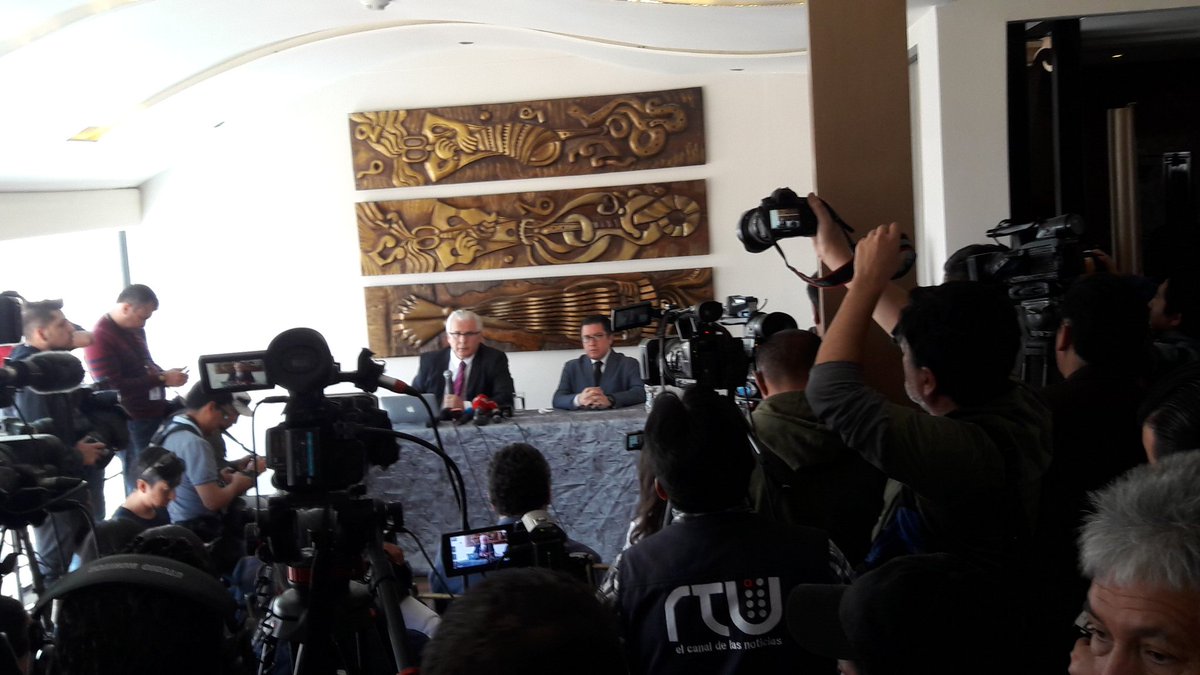
Julian Assange today launched a case accusing the government of Ecuador of violating his fundamental rights and freedoms. WikiLeaks general counsel Baltasar Garzón arrived in Ecuador yesterday to launch the case against the government. The move comes almost seven months after Ecuador threatened to remove his protection and summarily cut off his access to the outside world, including by refusing to allow journalists and human rights organisations to see him, and installing three signal jammers in the embassy to prevent his phone calls and internet access.
Electronic jammers have been placed inside the Ecuador embassy in London to prevent Julian Assange having access to social media, according to news.com.au and RT.com.

Today, 3 July 2016, on the birthday of the greatest truth-teller of our times, it might be appropriate to congratulate and celebrate with Julian Assange (and his friends and his cat).
But is is also appropriate to review the persecution he has endured now for so many years. And no one is more suited to that task than the United Nations, as per their ruling from 4 December 2015.
Their description of the conditions of Julian Assange's persecution unequivocally places the Swedish prosecutor Marianne Ny in a category solely her own, forever displacing Claes Borgström as the country's (perhaps the world's) most incompetent (and most heinous) jurist ever.
Interview with John Simpson of the BBC 18 September 2014.
On June 19, 2012, the Australian citizen Julian Assange, showed up on the headquarters of the Ecuadorian Embassy in London, with the purpose of requesting diplomatic protection of the Ecuadorian State, invoking the norms on political asylum in force. The requester has based his petition on the fear of an eventual political persecution of which he may be a victim in a third State, which can use his extradition to the Swedish Kingdom to obtain in turn the ulterior extradition to such country.
The Government of Ecuador, faithful to the asylum procedure, and attributing the greatest seriousness to this case, has examined and assessed all the aspects implied, particularly the arguments presented by Mr Assange backing up the fear he feels before a situation that this person considers as a threat to his life, personal safety and freedom.

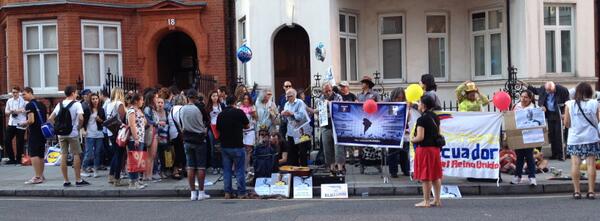
What: Solidarity Vigil in Support of Julian Assange and WikiLeaks
When: Thursday 19 June 2014 6-8pm
Where: Ecuadorian Embassy in London, No 3 Hans Crescent, Knightsbridge
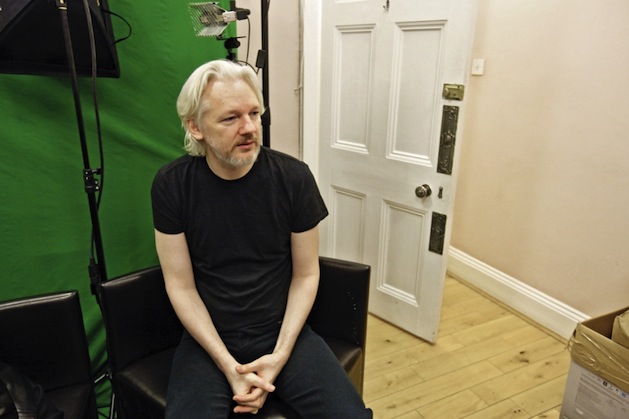
Friday 28 March. The Ecuadorean Embassy in London. Behind him: a green screen, in front of which he films for Skype and the social networks. Threatened by the United States, the founder of WikiLeaks has been confined for two years to a room at the Ecuadorean Embassy in London. He was visited by Eva Joly who is working on breaking the deadlock.
Late on Wednesday evening 15 August 2012, the Metropolitan police surrounded the Ecuadorean Embassy in London. This followed the publication by the Ecuadorean government of the aide memoir from William Hague, the British Foreign Secretary, on how the diplomatic status of their London embassy could be revoked.
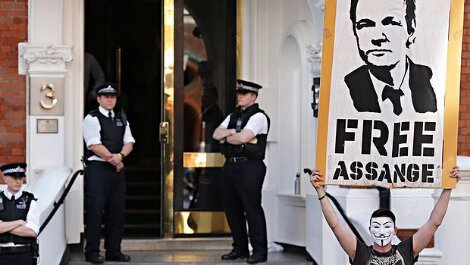
Observers assumed that the arrival of the police must be the presage to a raid. For those watching the unfolding events, in the end it all turned out to be an anticlimax. Though the outcome could have turned out very differently had it had not been for the interventions of certain cyber warriors - in the UK, Australia and elsewhere - whose quick-wittedness may have ensured that a major international incident was averted.
Edward Snowden was expected to fly to Havana today at 14:05 Moscow time, together with WikiLeaks legal advisors. But Snowden's seat 17A was empty at takeoff, and no one seems to know where he is. Julian Assange has however stated that Snowden is safe and in good spirits. Assange says he knows where Snowden is but will not say.
Earlier this morning, WikiLeaks announced that NSA whistleblower Edward Snowden had left Hong Kong with the assistance of WikiLeaks legal advisors.
FLASH: WikiLeaks has assisted Mr. Snowden's political asylum in a democratic country, travel papers ans safe exit from Hong Kong. More soon.
— WikiLeaks (@wikileaks) June 23, 2013
UPDATE: Chilean journalist @PatricioMery advises ex-detective Ulloa has now left the Ecuadorean Embassy in Santiago, and confirms he is "safe and sound". He adds with a wink: "I don't know where he is. ;-)"
WL Central presents an exclusive interview with Chilean journalist Patricio Mery, who claims the CIA has been actively plotting to destabilise or even assassinate Ecuador’s President Rafael Correa, after US anger over decisions such as the granting of political asylum to Julian Assange and the termination of the US lease on a military base in Manta.
Senator the Hon Bob Carr
Minister for Foreign Affairs
PO Box 6100
Senate Parliament House
Canberra ACT 2600
14 January 2013
Dear Minister,
Please find below a series of statements made by members of the Swedish Executive and government officials on the Assange case.
Senator the Hon Bob Carr
Minister for Foreign Affairs
PO Box 6100
Senate Parliament House
Canberra ACT 2600
28 November 2012
Dear Minister,
Please find below a series of links to evidence relating to the existence of a criminal grand jury investigation into Wikileaks.
Thursday December 20th, 19:00 GMT
(Not checked to delivery)
Six months ago - 185 days ago - I entered this building.
It has become my home, my office and my refuge.
Thanks to the principled stance of the Ecuadorian government and the support of its people I am safe in this Embassy and safe to speak from this Embassy.
And every single day outside, people like you have watched over this embassy - rain hail and shine.
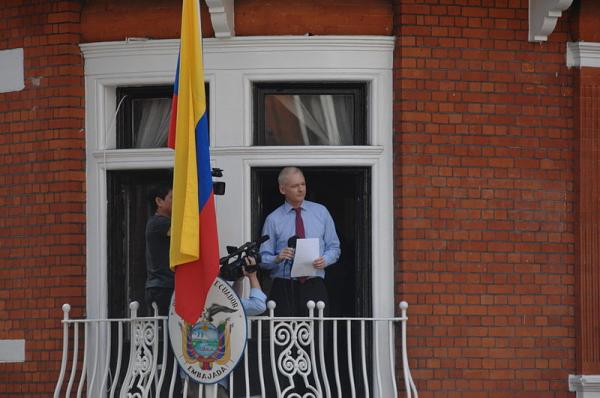
Sources have announced that on the evening of Thursday, December 20, 2012, WikiLeaks editor-in-chief and Australian Senate candidate Julian Assange will deliver a Christmas speech from the Ecuadorean embassy in London. The December 20 speech marks six months of Assange's stay at the embassy, where he has sought refuge since June in order to resist extradition to Sweden and to the U.S. This will also be Assange's first public address since he confirmed his candidacy for the Australian Senate earlier in the week.
 Julian Assange has reportedly confirmed his candidacy for the Australian Senate in the 2013 federal election. The WikiLeaks editor-in-chief has also announced the imminent formation and registration of a WikiLeaks political party, which would promote government transparency and oppose recent erosions of individual privacy.
Describing the process of forming of the WikiLeaks party as "significantly advanced," Assange has stated that "a number of very worthy people admired by the Australian public" have offered to stand for election on a party ticket. Reportedly, a draft party constitution is undergoing legal review, and Assange has consulted journalists, legal experts, and other WikiLeaks supporters regarding his Senate candidacy. Assange's biological father, John Shipton, is said to have handled the beginning phase of the party's formation.
.jpg "Bashar al Assad") Ecuador's President Rafael Correa stated in an interview this month that his government would consider granting political asylum to Syrian head-of-state Bashar al Assad. President Assad is reportedly mulling asylum for himself, his family members, and close associates, in the event that he is forced to flee Damascus as the bloody civil war in his country escalates.
Ecuador's President Rafael Correa stated in an interview this month that his government would consider granting political asylum to Syrian head-of-state Bashar al Assad. President Assad is reportedly mulling asylum for himself, his family members, and close associates, in the event that he is forced to flee Damascus as the bloody civil war in his country escalates.
Sources state that, in a bid to explore the possibility of asylum, Syria's Deputy Foreign Minister, Faisal al Miqdad, recently traveled to Ecuador, Venezuela, and Cuba, bearing letters from Assad to the President of each country.
Correa confirmed that Miqdad visited Quito in late November, but said that the purpose of the trip was to thank Correa's administration for its "objective stance" regarding the conflict in Syria. Both Ecuador's President and his Foreign Minister denied reports that Assad had requested political asylum. However, since then Correa has spoken out regarding the possibility of hosting Assad, saying:
"Any person that requests asylum in Ecuador, obviously we are going to consider as a human being whose basic rights we have to respect … Can we believe all those news stories on violence, the dictator? Let's remember what was said about Iraq."
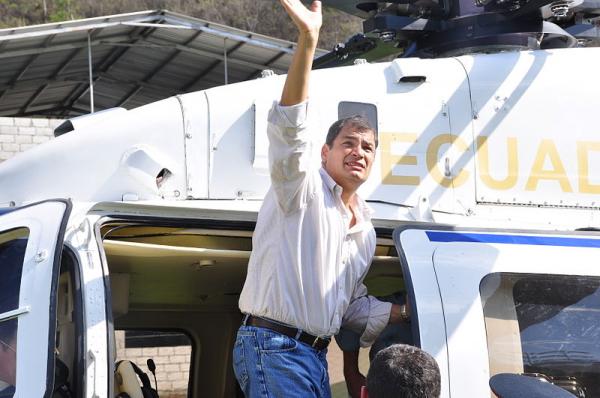 Controversy erupted earlier this week after the journalism department of Argentina's National University of La Plata awarded Ecuadorean President Rafael Correa the Rodolfo Walsh Prize for freedom of expression. Proponents of media freedom have harshly criticized Correa for his treatment of the Ecuadorean press. But such criticisms fail to acknowledge the reasons underlying the media policies of President Correa, whose government recently granted political asylum to government transparency advocate and WikiLeaks Editor-in-Chief Julian Assange.
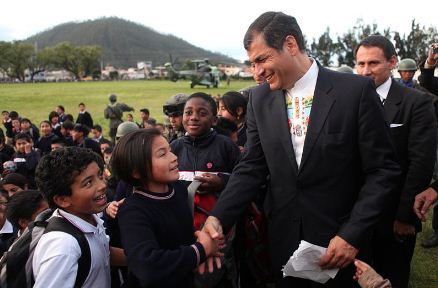
The South American media has reverberated lately with reports that the CIA has been using drug money in efforts to destabilize the government of Ecuador's President, Rafael Correa. If these stories are accurate, then the plan's exposure and apparent failure may illustrate the impotence of traditional U.S. interventionism in the new South America, which increasingly rejects traditional political and economic servitude to its northern and European neighbors.
One week ago, on August 19, Julian Assange gave a speech, and he did so from a balcony of the Ecuadorian embassy in London as the British government refuses to recognize a fundamental Human Right: the right to asylum. A large number of reports and opinion pieces about his first public appearance in two months has since been published, a significant amount of which don’t represent at all the truth and the complexity of his present situation. Very few journalists expose the political persecution WikiLeaks is target of or the accumulating evidence relating to Julian Assange's potential extradition to the U.S., yet it is not hard to come by vitriolic satires of his alleged personal habits or, even worse, his confinement and status as a political refugee. But in his address to supporters and the press last week, Julian Assange made a simple and very important plea, calling for an end to the oppression of activists and whistleblowers, and the U.S. secret Grand Jury investigation of WikiLeaks.
Victoria Nuland, spokeswoman for the U.S. State Department, has been confronted with questions concerning whether the U.S. has any future intention to extradite and prosecute Julian Assange for WikiLeaks publishing, following Ecuador granting him political asylum due to fears of such prosecution having been considered valid.

This work is licensed under a Creative Commons Attribution-NonCommercial-NoDerivs 3.0 Unported License.
Theme by Danetsoft and Danang Probo Sayekti inspired by Maksimer


