
WikiLeaks Truck is still missing after it was taken from its owner by the NYPD at Occupy Wall Street. Artist Clark Stoeckley, the owner and driver, was pulled over and subsequently arrested, possibly unlawfully, for ‘obstructing government administration’.
 Clark refused to consent to a search [video here] and the truck was towed by the NYPD. He was released from jail on November 18 but the truck, containing his personal belongings, is still in an unknown location. Although Police assured Clark Stoeckley the WikiLeaks Truck was to be found in an impound lot in Brooklyn, the truck never made it to said impound lot.

 After 17 months in confinement, Bradley Manning will appear before court on December 16, for an Article 32 pretrial hearing, his lawyer announced today.
The hearing, expected to last 5 days, will take place at Fort Meade, Maryland and will be held publicly “with the exception of those limited times where classified information is being discussed”.
The primary purpose of this hearing is to evaluate the US Government’s case against Manning.
Supporters will be outside the Court as he arrives, for a demonstration also tied to the celebration of his 24th birthday on the following day, December 17.
On December 17,
please write or send small gifts to Bradley Manning.
And don’t forget you can also contribute to his defense with a donation.
Protesters gathered in Canberra this morning for a rally in support of WikiLeaks, Julian Assange and Bradley Manning. The protest happened as U.S. President Barack Obama was visiting Canberra to announce the expansion of U.S. military presence in Australia.
Outside the Australian Parliament House, chants of Assange and Manning, let them go - Let us have our right to know were heard.
Christine Assange spoke against the extradition of her son Julian to the United States, declaring: “my son could be extradited to Sweden and then the U.S. in four weeks” where he could face “U.S. style justice”. She then referred to the appalling treatment of alleged whistleblower Bradley Manning - who has been under pre-trial detention in a military prison for 563 days - and the Australian government’s refusal to intervene for Julian Assange’s protection, saying: “The Australian government has done nothing for Julian.” She condemned the attitude of Australian leaders whom she described as ‘star-struck’ by Obama’s presence.

This is a "WikiLeaks News Update", a news update of stories relating directly to WikiLeaks and also freedom of information, transparency, cybersecurity, and freedom of expression.
November 17 is a day of global support for Julian Assange, WikiLeaks, and Bradley Manning.
On the occasion of President Obama’s visit to Australia to mark the 60th anniversary of the Australian-US war alliance and the announcement of the expansion of U.S. Military presence in the country, an antiwar protest in Canberra, outside the Parliament House, will start at 10:30 am.
This protest is also in support of WikiLeaks and Julian Assange, who currently risks extradition to the United States, should his application for a Supreme Court appeal be rejected by the High Court and extradition to Sweden granted. In which case the U.S. could apply for his ‘temporary surrender’. This would enable him to be extradited to the U.S.

This is a "WikiLeaks News Update", a news update of stories relating directly to WikiLeaks and also freedom of information, transparency, cybersecurity, and freedom of expression.
Today Julian Assange’s legal team filed an application to have his extradition case taken to the Supreme Court, based on the following points:
1) Whether a European Arrest Warrant issued by a partisan prosecutor working for the executive (i.e. not an independent judge or investigating magistrate in the civil law system) is a valid Part 1 Warrant issued by a "judicial authority" within the meaning of sections 2(2) & 66 of the Extradition Act 2003?
This point argues that the decision goes against parliamentary intent in the 2003 Extradition Act (see SwedenVsAssange).
2) Whether a person in respect of whom no decision to prosecute has been taken can be said to be ’accused’ within the meaning of sections 2(3)(a) of the Extradition Act 2003?
On December 5, in a public hearing at the Royal Courts of Justice (London), the High Court will decide whether these two points are 'of general public importance'. If that is considered to be the case, the appeal will then proceed to the Supreme Court.

This is a "WikiLeaks News Update", a news update of stories relating directly to WikiLeaks and also freedom of information, transparency, cybersecurity, and freedom of expression.
Starting today: a Call-in to The White House and Military to Demand UN Access to Bradley Manning will take place throughout the week: Each day of the week you can help by calling the number for a different official with key influence on the outcome of the case.
 The Bradley Manning Support Network announces: "we will expand our efforts by organizing mass call-ins to five different government offices, disrupting activities of those whose job it is to silence whistle-blowers with specific demands that can lead to a fairer trial."
The first two contacts, whose phone lines are to be flooded with calls demanding justice for Bradley are:
* Secretary of the Army Public Affairs Officer Lt. Anne Edgecomb: 703-697-3491
[email: Anne.edgecomb@us.army.mil]
* Army Chief of Staff Public Affairs Officer Lt. Col Alayne Conway: 703-693-4961
[email: Alayne.conway@us.army.mil]
This is a "WikiLeaks News Update", a news update of stories relating directly to WikiLeaks and also freedom of information, transparency, cybersecurity, and freedom of expression.
Upcoming Appeal Hearing for WikiLeaks whistleblower Rudolf Elmer
On November 17, whistleblower Rudolf Elmer's appeal hearing will take place. Prosecution requests 'convicted on all charges' verdict and increased sentence:
"Prosecution Office Winterthur/Unterland wants to make the case that Swiss Bank Secrecy protects the data in the Cayman Islands and that based on a former employment agreement Swiss Bank Secrecy applies also to Rudolf Elmer working in the Cayman Islands.
Prosecution Office wants to make the case that Swiss industrial secrecy laws also apply to the Cayman Islands in the case of Rudolf Elmer and accuses him of disclosing Julius Baer’s secrets on how it uses the operation in the Cayman Islands providing Trust & Company, Mutual and Hedge Fund services as well as the administering of Special Purpose Vehicles e.g. offshore companies of Carlyle, Washington D.C. within the Julius Baer Cayman office.
This is a "WikiLeaks News Update", a news update of stories relating directly to WikiLeaks and also freedom of information, transparency, cybersecurity, and freedom of expression.
Collateral Murder changed U.S. army interrogator's perspective on the Iraq war
On Veterans day, The Atlantic interviews Michael Patterson, a former U.S. army interrogator whose decision to leave the military and current participation in the Occupy Movement (Michael is staying at Occupy DC) were motivated by the video Collateral Murder, released by WikiLeaks on the 5th April 2010:
"... I ask him what was the switch for him and when. He explained that it was WikiLeaks. It was the footage of the Apache helicopter gunning down Iraqis released by WikiLeaks in April of 2010. Up to that point he had been interrogating Iraqis and using what he describes as psychological torture. He was 10 years old when the World Trade Center was hit. He wanted to fight terrorism in Iraq. He bought into the whole thing, he tells me. He had been looking forward to signing up ever since the 5th grade and then, suddenly, last November, he found himself watching a video of his fellow soldiers gunning down Iraqis on the street and it all changed for him.
This is a "WikiLeaks News Update", a news update of stories relating directly to WikiLeaks and also freedom of information, transparency, cybersecurity, and freedom of expression.
Update: Former and current WikiLeaks associates Birgitta Jónsdóttir, Jacob Appelbaum and Rop Gonggrijp's twitter records are to be disclosed, U.S. District Court Judge Liam O’Grady ruled today. The unsealing of docketing information pertaining to the case, and of relevance in the context of the Grand Jury investigation on WikiLeaks, was however refused.
Jacob Appelbaum reacted to the decision with the words: Today is one of those "losing faith in the justice system" kind of days.

(Photo) Wikileak's Julian Assange wearing an Anonymous mask on October 15th at #OccupyLXS camp in London
Now that the grassroots movement that started inadvertently with the Arab Spring has gone global, it is necessary to cast a backwards glance to try and figure out, with some perspective, the dynamics of what has happened, physically and conceptually, over the last year. We propose a simple vision of the process of uprising in 2011, which was consolidated on the past 15th of October as a new culture of popular resistance and creativity. We also aim to point out the recent or enhanced concepts born in the collective consciousness of society during this period.
Authored by William Shaub
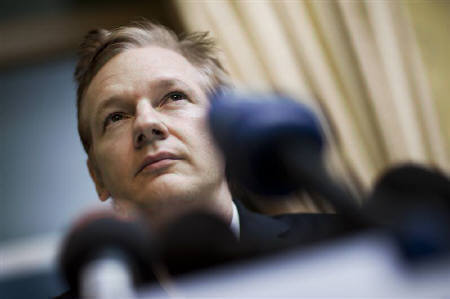
Julian Assange has become more than an agent of transparency; he’s our resourceful David in a 21st century fight against thousands of steroid-enhanced Goliaths.
Australia’s The Age is reporting what many of us familiar with the WikiLeaks saga have foreseen:
Kevin Rudd and his foreign affairs department have been accused of all but ignoring pleas from Julian Assange’s legal team to protect the WikiLeaks founder from a possible death penalty in the US.
The foreign affairs department may have also been caught out in an embarrassing lie, after telling The Age they had replied to a letter from Assange’s British lawyer, Gareth Peirce, when they had not.
Tony Kevin, an Australian diplomat of three decades who served as ambassador to Poland and Cambodia, was critical of Mr Rudd’s handling of the Assange case, saying Australia appeared unprepared to grapple with its highly political nature.
Indeed, Australia is not the only country “unprepared to grapple” with the highly political nature of Julian Assange’s court case, but perhaps the most important. The US is not hesitating to use its ability of limiting the social sovereignty of other countries for the purposes of ‘security,’ and governments are clearly not interested in falling out of US favor. Thus, Australia is buckling to US political pressure and acquiring real complicity in Assange’s possible extradition to the US.
The result is the persecution of perhaps the most innovative web activist in history.
Freedom of speech should be free. It should not have a price tag, but it does in the world we live in, and it is a high one. For the course of its five year history, Wikileaks has been bearing the astronomical legal and adminstrative costs of exercising freedom of expression in the pursuit of justice. Now it needs your help.
Wikileaks' explicit mission is to publish material whose reform-potential is so great that powerful organizations and governments are willing to expend their resources to prevent that material ever entering the public record - to prevent you and I from ever hearing of it.
As a whistleblower organization, Wikileaks' primary function is to facilitate conscientious leaks. The first line of defense for powerful organizations is to cloak their wrongdoing in secrecy. Secrecy is achieved by using coercive means to deter the disclosure of information to the public. Individuals are often compelled to conceal evidence of wrongdoing within powerful factions because the personal consequences of doing so would be dire.
By providing - at cost - a secure and robust mechanism by which conscientious individuals can leak such materials anonymously, Wikileaks ensures that secrecy can never be so complete as to suppress evidence of the misconduct of the powerful. It creates, in effect, a safety-valve for secrecy, so that there will always be a conduit by which people of good conscience can get information to the public, at reduced risk to themselves. To date, no other single organization has performed this function as effectively, or as consistently.
The second line of defense, for powerful organizations, is to attack Wikileaks, and to prevent it from publishing the information it receives. The whistleblower group, therefore, draws upon itself the fire that would otherwise be directed at the whistleblowers whose identity it is sworn to protect. At various times in the past few years, this has taken the form of:
This is a "WikiLeaks News Update", a news update of stories that are obviously related to WikiLeaks and also freedom of information, transparency, cybersecurity, and freedom of expression.
The judgement on the extradition of Julian Assange to Sweden will be delivered tomorrow at the Royal Courts of Justice (London), at approximately 9:45 am GMT time.
A manifestation of support will take place outside the Court - starting at 9:00 am (more details here). Feel free to drop by: your presence there is important as a public affirmation of support toward Julian and WikiLeaks. So be there, and help raise awareness!
Remember, WikiLeaks needs you.
Following a press conference at the Frontline Club on the 24th October – where it was announced WikiLeaks was to temporarily suspend publishing activities to concentrate efforts on beating, through a major fundraising campaign in addition to legal action, the banking blockade that has deprived the publicly funded organization of 95% of its income - it is now much easier to donate to WikiLeaks, via SMS for instance, and you can also learn how to contribute with your skills as an internet user.

Not speaking often publicly on general issues is a main attribute of the top leadership in the Syrian Baathist regime. They rarely allow themselves to be faced and challenged by the media. The regime tends to convey its messages via different proxies and mouthpieces who are regime-linked. These unofficial spokespeople meet foreign officials or media to express the official line.
Take for example the Syrian uprising which is seven months old now. Rarely has a Syrian official has showed up in any TV show since the 'troubles' started in Syria; nothing like an interior minister, sub-minister or even a spokesman. The task is usually done by 'analysts', 'academics' or 'strategists' who are actually fiercer than the regime itself in expressing the official line. A lot of these names have become infamous now as they have been hosted almost full-time on satellite channels like AlArabiya and AlJazeera. Dr. Taleb Ibrahim is one of these. Of the few times the Syrian Foreign Minister Walid Muallem spoke to the media for example, they were in press conference type meetings rather than debate talk show types. Still, he managed to wipe out new countries when he spoke.
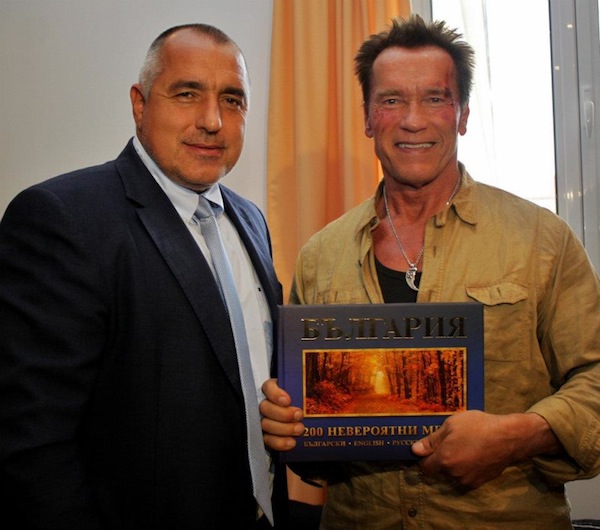
Movie stars Arnold Schwarzenegger, Sylvester Stallone, Chuck Norris, Bruce Willis and Jason Statham are actually in Bulgaria for the shooting of the "The Expendables 2" at the Nu Boyana Film Studios.
Bodyguard services are provided by a Bulgarian security firm connected to the most powerful local organized crime group TIM, according to secret cables sent from the US Embassy in Sofia and published by Wikileaks.
Pictures taken during Schwarzenegger's arrival at the Sofia International Airport, published in Bulgarian media, show a Mercedes SUV, waiting for the actor, with license plate C4401XA, registered to a company owned by the Varna-based TIM and commonly used by the TIM boss Ivo Kamenov. According to unconfirmed reports, the SUV is armored to the 7b level, which is very rare in Bulgaria.
Another picture portrays kick boxer Todor Todorov standing close to Schwarzenegger. Todorov is a competitor of the TIM sports club and a bodyguard, employed by the Sark Group company, founded in 2004 by the former chief of security of TIM boss Marin Mitev.
The security activities of TIM are spread among several firms with the most popular one being TIM EOOD, offering VIP security services in Bulgaria and abroad, according to the official internet page tim.bg.
The Nu Boyana studios, contacted by bivol.bg, have declined giving information about the company providing security for Hollywood stars, shooting in Sofia, and in particular for Schwarzenegger.
TIM - "The up-and-coming star of Bulgarian organized crime"
Authored by James Hill
Julian Assange's speech at Trafalgar Square at approximately 15:30 on 8th October 2011. A transcript of the speech appears below. Apologies but an introductory sentence or two are missing from the beginning of the speech as I didn't consider recording until after taking a photo when Mr. Assange appeared on stage.
". . . and that is something I want to talk about. What can we do with our values, what can we do at all in relation to this war? Because the reality is Margaret Thatcher had it right; there is no society any more. What there is is a transnational security elite that is busy carving up the world using your tax money.
To combat that elite we must not petition; we must take it over.
We must form our own networks of strength and mutual value which can challenge those strengths and self-interested values of the warmongers in this country and in others that have formed hand in hand an alliance to take money from the United States, from every NATO country, from Australia and launder it through Afghanistan, launder it through Iraq, lander it through Somalia , launder it through Yemen, launder it through Pakistan and wash that money in peoples blood.
I don't need to tell you the depravity of war, you are all too familiar with its images, with the refugees of war, with information that we have revealed showing the everyday squalor and barbarity of war.
Information such as the individual deaths of over 130,000 people in Iraq. Individual deaths that were kept secret by the US military who denied that they ever counted the deaths of civilians.
Instead I want to tell you what I think is the way that wars come to be and that wars can be undone.
 The Lebanese daily newspaper Almustaqbal reported today that the head of Free Patriotic Movement (FPM) in Lebanon General Michel Aoun referred to Hezbollah as a ‘terrorist organisation’ in one of the Wikileaks cables (06Beirut413). Other media outlets reported the story referring to Almustaqbal, and one of them was Lebanese Broadcasting Corporation International (LBCI), where the author read this piece news (on their website).
Almustaqbal newspaper is owned by the business tycoon, Hezbollah’s political opponent and Former Lebanese Prime Minister Saad Hariri. If this is true, it will be a blow to the current alliance that exists between Michel Aoun and Hezbollah. This alliance has been the corner stone of what’s known as ‘March 8’ camp in the Lebanese politics, which is basically a pro-Hezbollah alliance. Hariri is the leader of ‘March 14’ camp, which is an anti-Hezbollah alliance.
Hezbollah is a main player in Lebanese politics, and has a main regional dimension too. It represents a fore front extension of the alliance between Syria, Iran on the Lebanese borders which stands up to Israel. Going back to the subject cable 06Beirut413 and the story in Almustaqbal. The author actually read this cable before Almustaqbal, and soon after its release. The author decided then NOT to write about it, as he didn’t find anything unusual or already not available in the public domain.
Authored by Nikolas Kozloff
Chávez's "Charm Offensive"
Even during the darkest days of the Bush administration, Venezuela made efforts to mend relations with Washington. In 2005, for example, Chávez's Minister of Communications Andrés Izarra met with U.S. ambassador in Caracas William Brownfield. In an earlier meeting, Brownfield had suggested that Venezuelan journalists visit the U.S., an idea which Izarra had found lacking as "such visits might merely be indoctrination trips by the U.S. government." Nevertheless, during his follow up visit Izarra suggested that the two countries should explore the idea of conducting journalist exchanges, provided of course that the U.S. would follow up in kind and "invite U.S. journalists to Venezuela for reciprocal visits to poor Venezuelan communities where they might witness the government of Venezuela social missions."
Izarra's offer seems reasonable enough, yet the caustic and dismissive Brownfield was skeptical of Chávez's so-called "charm offensive." The ambassador remarked that Izarra had acted "very severely" toward several accredited U.S. journalists based in Venezuela. Izarra retorted that several American reporters, including the correspondent of the Miami Herald, had been "consistently and erroneously critical of the government of Venezuela and its policies," and therefore the Minister believed he "had a duty to criticize their errors."
Predictably, the meeting did not bear any fruit. It was unlikely, Brownfield remarked, that the U.S. Embassy would ever coordinate any journalist visits to Venezuela. Writing to his superiors in Washington after the meeting, Brownfield declared sarcastically "the charm offensive continues...Our judgment is still that the government of Venezuela offensive is tactical in nature."
Charitable View of Obama
A secret diplomatic cable [08SOFIA185], released by Wikileaks and dated March 27, 2008, reveals that Bulgarian Ambassador in Washington, DC, now serving a second term there, Elena Poptodorova and then Deputy Defense Minister, Sonya Yankulova, have informed American Ambassador in Sofia John Beyrle about plans to increase the Bulgarian contingent in Kandahar by fifty rangers, months before the official decision of the Bulgarian cabinet.
The cable is also shading light on the steady pressure exerted by US officials on the Government of Bulgaria to expand its Afghan contribution with new contingent.
In two separate meetings, Poptorova and Yankulova have stressed to Beyrle that this had been sensitive information while the diplomat wrote in the cable, classified as secret, that both ladies must be under a strictly protect status.
"Bulgaria is set to announce a decision to deploy an additional 50 soldiers to take over the Entry Control Point Number Four mission at Kandahar Airfield. It is keeping this decision under tight wraps for now. We expect the formal decision will be made just before the NATO Summit, and the announcement itself probably in Bucharest by the Prime Minister. Both Ambassador Poptodorova in Washington and Deputy Defense Minister Yankulova (strictly protect) have foreshadowed this outcome and the sensitivity of the decision and announcement timing," Beyrle informs in his report.
"While a formal decision is still days off, and there is still some scope for a mis-step, we would be surprised if Bulgaria does not come through," the Ambassador concludes.

This work is licensed under a Creative Commons Attribution-NonCommercial-NoDerivs 3.0 Unported License.
Theme by Danetsoft and Danang Probo Sayekti inspired by Maksimer


