(Written under the stress of this and this environment.)
Many mysteries remain and questions still go unanswered about what just happen in Egypt last week, particularly with regards to Mubarak and Sulieman. Who even knows where they are and what they're doing now?
It is now well established that Egypt's President Hosni Mubarak was suppose to have stepped down when he spoke on state TV, 45 minutes after the announced time, late Thursday evening. That's why NBC News reported the 'scoop' early in the day, why various U.S. government sources were making assurances and even the supreme council of the Egyptian army, and that is where the power really lies anyway, all but proclaimed it.
The fix was in. Mubarak had promised to resign and turn his powers over to his new Vice President Omar Suleiman. Then at the last moment he threw the hook again. This was the third time that he had spoken publicly since the mass protests began on January 25th and it is being said that on each of the previous occasions be had been expected to resign but twice, on Jan. 27th & Feb. 1st, he had failed to do so but this time it was for sure.
There is a freedom of movement in a free field of archetype and symbol that enables both user and audience to observe without disclosure, absorb without acquisition, and create without demand for completion.
The repetition of archetypical representation uncovers both the user's and audience's collective mythologies, thereby revealing:
The anonymous is personal.
When Google Marketing Executive for Middle East and North Africa [MENA] Wael Ghonim went missing amidst the chaos that was enveloping Cairo in the first week of the uprising in Egypt, Google started a search. So did friends and family.
He took six days off from Google, saying he had to take care of some "personal business." The day before the big January 25th protest he tweeted "Heading to Tahrir square now. Sleeping on the streets of Cairo, trying to feel the pain of millions of my fellow Egyptians. #Jan25"
His last tweet, before he went missing was on Thursday, 27 January. He was helping another Internet user get around Egypt's web censorship:
@Ghonim how can you tweet when its blocked??
He responded:
@SweetOwl proxy servers
At first Google refused to confirm that Wael was missing, In an email, a spokeswomen said "We care deeply about the safety of our employees, but to protect their privacy, we don't comment on them individually."
After the positive feedback on the report I did last time - I decided to go once more to London. A different journey: Last time was spur of the moment and very intuitive. If Gallilei lived today, I would have wanted to go to THAT process and this is about the biggest thing to happen in my profession (archiving) for the coming 100 years!!! I think Wikileaks is also a sign of a lot of other things that will start shifting.
This time my decision is more controlled. I have less to 'do' for myself and one of my purposes is definitely pure support. I feel that at this time consistent, levelheaded support is very needed.
I was again early and noticed that there was slightly less press and slightly less security. The latter probably because the police now put a fence round the entrance and the road throughout and felt more in control that way. I walked straight to the entrance to queue for the public and at 8:30 could proceed to the court room without further ado.
On the public gallery the security was one policeman up - but it was possible to wait there. Courtroom staff were less itchy than they were the last time. There were now two women in charge. Despite supporting Wikileaks, I have frowned my eyebrows at remarks that a pink cashmere sweater is apparently not appropriate on official occasions. The eyes of the people making that remark would have popped out here. Belmarsh Crown Court female staff loves high, very high (!) heels and I saw several people in fishnet stockings!
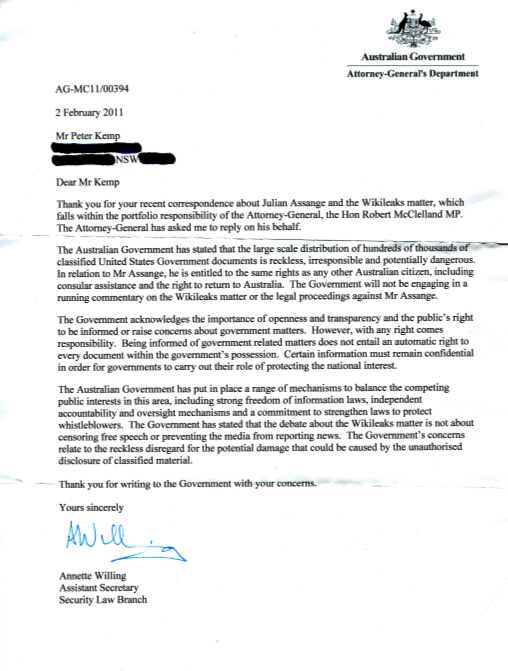
The Australian attorney general's response to an open letter to the Australian Prime Minister Julia Gillard re Julian Assange
Julian Assange appears tomorrow, 7 February, at Westminster Magistrates Court for what has been announced as a two-day hearing, but judging from past extradition hearings in the UK, it is likely (with appeals) to take much longer, even a year or more, with the second-last word being that of the Supreme Court (formerly House of Lords) and then, under certain circumstances, the last word from the Home Secretary.
Readers should note that the procedure is not to judge the actual case on its merits as a criminal procedure but to judge it according to relevant sections of the UK Extradition Act. Such evidence of the alleged offences that has surfaced is only relevant indirectly, such as to prosecutorial abuses, not to the arguable merits of that evidence and a future case in Sweden if extradition occurs.
The Skeleton Argumentbegins with a challenge to prosecutor Ms Ny’s authority to issue an European Arrest Warrant (EAW). The case of Enander v. The Swedish National Police Board [2005] EWHC 3036 (Admin) is cited; it states that only the Swedish National Police Board is the authorised authority.
This evening two of the editors who worked with WikiLeaks on the publication of the Afghan and Iraq war logs and the diplomatic cables, Alan Rusbridger of the Guardian and Bill Keller of the New York Times, will discuss their interactions with WikiLeaks on a panel hosted by the Columbia University Journalism School in New York City.
Jack Goldsmith, the former assistant attorney general who raised alarms within the US Department of Justice about DoJ legal opinions on torture and now a Harvard University law professor, will join the panel as discussant. The panel will be moderated by Emily Bell, director of the Tow Center for Digital Journalism at CJS.
In a recent tweet, WikiLeaks referred to some members of the panel as its "detractors."
The panel will be livestreamed at the CJS site at 7 pm EST.
We owe a huge debt of gratitude to Wikileaks, not only for the exposure of the lies and deceptions of various world powers, not just for exposure of the inner workings and chicanery of state institutions and corporations, their hypocrisy and double dealings, but also for what follows in future: the advancement of human rights for all, and a major corollary of that, the increased potential for prosecution of those who have prima facie cases to answer for breaches of human rights.
Firstly some analogies with theoretical physics.
For theoretical physicists like Lawrence Krauss, (whose understandable scientific explanations of the universe leave this writer in awe), supernova are useful as standard candles …for which the intrinsic brightness, the absolute magnitude, is known. This allows the object's distance to be measured from its actual observed brightness, or apparent magnitude. With distance and the amount of spectrum “redshift” the expansion of the universe can be measured, and its present acceleration.
If I may draw an analogy, for those concerned about human rights, Wikileaks is akin to a supernova, it is our “standard candle,” so to speak. Not only is it an additional and great illumination for breaches of our measurable “universal” human rights but it has created a new standard for real journalism and in so doing has motivated the world in moral and legal outrage to a significantly higher plane. It has struck a chord with so many, in so many dimensions all over the world. It is difficult to quantify those dimensions, but the human rights aspect of it is not only real but palpable.
Completely unintentionally, revolution has been the theme of this week. I read Paulo Freire’s Pedagogy Of The Oppressed and saw the musical Fela! courtesy of the National Theatre broadcast. The South Africa retelling of the story of Christ (Son of Man) mirrored Fela! remarkably – for good and ill. The documentary on Antonio Negri (A Revolt That Never Ends) explored the workers movements in Italy in the 70′s, and his academic work on the Multitude since his time in prison.
Bill Keller, the New York Times' executive editor, published an enormous article on the 26th of January about the New York Times' dealings with WikiLeaks. The article develops further the running story of WikiLeaks' relationship with its media partners, the subject of a Vanity Fair piece earlier in the month.
Much has been made of the negative light in which Julian Assange appears in the article. Wired's Kim Zetter published a digest piece, in which the more absurd claims of the piece are given particular attention but little critical treatment. The more colourful parts of the article were, predictably, grist to the celebrity gossip mill.
Perhaps the most important thing about the article, though, is that it is the first authoritative indication that the Times is willing to take a stand for media freedoms in the United States. During the height of official outrage over Cablegate late last year, when the use of the Espionage Act was being widely touted as a convenient way to perform an end run around First Amendment protections, it fell to the Washington Post's editorial section to issue a strong defense of freedom of speech. The Times, with its history of media partnership with WikiLeaks, remained conspicuously silent.
No longer. Keller now issues a strong (albeit heavily qualified) defense of those freedoms:
Talking-point politics, taken for political discourse is delusion. It's akin to the cunning nature of chatter in the mind of a neurotic. It masquerades itself as thinking. I will not offer the reader a well-intentioned flag to die under. It's contrary to my nature to send anyone to my gallows. I believe in wisdom. Living according to my conscience is the greatest pleasure. Its orgasm is sanity. In doing (and not doing the above), I hope that I have paid respect to any reader who happens to offer this essay his or her kind and undeserved attention.
If I were asked who the most relevant and important voices in post-modern political thought are, I would say former Eastern European dissidents. I only became acquainted with them three year after the Soviet Union collapsed. I was teased that I read them like ‘self-help’ for Eastern Europe. Not being too interested with the previous generations' culture war, I remarked, “Yes. But, also for the West.” Wikileaks, to me, is simply a larger dose of the medicine that these thinkers prescribed for the individual in the post-modern state.
We are indebted to Julian Assange who apparently instructed his counsel to make available the "Skeleton Argument" for the extradition hearing proper.
It was expected, per my previous post Extradition Part 3 that the issue of extradition (and arrest) for the purposes of investigation only, would be a highly significant issue for the extradition arguments, and so it was.
One part of that document however that shocked me, that I have discussed with colleagues (likewise shocked) was paragraph 88, the legal implications of which I was unaware. It now seems that some (or indeed all?) of the prospective charges of a sexual nature in Sweden do not have as a required element that the prosecution must prove (for a conviction to be sustained) the element of mens rea, the "guilty mind" otherwise known as the fault element.
The explosion of Wikileaks related news, and the manifestation of the internet's political potential to those who had previously ignored it, or only superficially acknowledged it, has led to a debate of increased intensity about the nature of the net, its political dimension, and its uncertain future. WL Central compiles some valuable commentary on this issue:
Rop Gonggrip's fascinating keynote speech from 27C3 projects an uncertain future, online and off, and offers some visions of what the role of the internet, and the hacker community, will be in this future. His riveting pessimism is tempered by a reassuring pragmatism, and a veteran's insight into the subject matter.
Common law conspiracy is an agreement by two or more to do an unlawful act, or to do a lawful act by unlawful means. The actus reus (guilty act) is the agreement itself. The mens rea (guilty mind) is the intention to carry out the unlawful act. Another way of putting it is that there must be a "meeting of the minds" to commit the unlawful act.
It does not matter that the conspiracy was not carried out, liability for common law conspiracy arises simply from the the agreement.
It goes almost without saying, that to avoid First Amendment protection of a hypothetical Espionage case (and I will leave those arguments to US constitutional lawyers), conspiracy appears to have a much greater prospect of success for the DOJ,
The following contains no commentary; only quotes from a well reported cable release earlier this week. It will quickly become apparent why no commentary is required.
FRANCE AND THE WTO AG BIOTECH CASE
Summary: Mission Paris recommends that that the USG reinforce
our negotiating position with the EU on agricultural biotechnology by
publishing a retaliation list when the extend "Reasonable Time
Period" expires. In our view, Europe is moving backwards not
forwards on this issue with FRANCE playing a leading role, along with
Austria, Italy and even the Commission.
Moving to retaliation will make clear that the current path
has real costs to EU interests and could help strengthen
European pro-biotech voices.
Both the GOF and the Commission have suggested that their
respective actions should not alarm us since they are only
cultivation rather than import bans. We see the cultivation ban as a
first step, at least by anti-GMO advocates, who will move next to ban
or further restrict imports. (The environment minister's top aide
told us that people have a right not to buy meat raised on biotech
feed

The nature of the Internet makes detailed, concise, well thought out arguments almost impossible. The fluidity, the ebb and flow of information all conspire against the well thought out essay. In the past weeks, months even, there has been numerous attempts by myself and others to boil down the main arguments, the main points to be made, to try and shine some light into the encroaching darkness. While some have made a good go of it, placing cap-stones on some of the more pressing issues; others have failed miserably. I am forced to concede, alas, I am in the "fail" category.
I can hardly count the numerous "beginnings" of essays; which, in my heart of hearts I felt, were Surly to illuminate and keep the darkness at bay. However, it seems, new information, new spins on old information come flooding; torrents of rumors, facts and fallacies kaleidoscope round; peculate and illustrate most macabre.
This will not happen now.
Further to my open letter on those inciting murder upon Julian Assange, this op ed style post again responds to those who say that Julian Assange should be kidnapped, executed, murdered or otherwise be "whacked", to use a favourite Hollywood gangster expression. It is a much expanded variant of the open letter to the inciters at Wikileaks Central.
The CIA and/or US military forces have been invoked by some, as the agents who would carry out such extra curial "services" of which it must be said, such actions both incitement and carrying the incitement out, are undoubtedly unlawful. Doubtless the early December Assange-illegal-posturing Prime Minister of Australia would not officially, take kindly to the latter course of action.
The web roll of inciters or borderline inciters is growing.

This work is licensed under a Creative Commons Attribution-NonCommercial-NoDerivs 3.0 Unported License.
Theme by Danetsoft and Danang Probo Sayekti inspired by Maksimer