On 2nd March 2011 at 9.15am a meeting was held, organised by Andrew Laming (Liberal Party MP Bowman Qld) at Parliament House Canberra to allow federal parliamentarians who wished to attend, some insights into the matters of Julian Assange facing extradition from the UK to Sweden, and facing (subject to that extradition process) a possible trial in Sweden and another possible extradition to the USA thereafter.
Among others, MPs Andrew Laming, Malcolm Turnbull, Doug Cameron and Sarah Hanson-Young were in attendance, along with parliamentary staff members.
Three speakers made themselves available for oral presentations and questions: Greg Barns, barrister from Tasmania; former Australian diplomat Tony Kevin and Peter Kemp, solicitor from NSW. The latter two made written material available for the parliamentarians, reprinted below with their permission. Written material was also provided by Jennifer Robinson, UK counsel for the Julian Assange. That material is reprinted with permission here.
After short addresses by each of the three speakers, the meeting was opened for questions and summaries of each speaker in the proceedings appears below, after biographies.
 The following is a chat that recently took place on the Swedish news website Aftonbladet with Julian Assange. Assange talks about his trial, the possibility of extradition to the United States, why he thinks he won't get a fair trial in Sweden, how WikiLeaks is faring currently, whether WikiLeaks will go on if he is found guilty and sentenced to jail, and more. Here it is re-published in full.
Julian Assange has lost the case at the extradition hearing. Full ruling here in PDF. While this writer expected considerable difficulty for Assange's case on count 4, Chief Magistrate Howard Riddle found all four counts to be extraditable. More on that and his findings for another day.
An important first point is that this extradition finding should not be misinterpreted as some species of proven guilt. Julian Assange is still presumed innocent until proven guilty by a proper trial process. The extradition process and appeals to follow in the UK are not that trial process.
The European Arrest Warrant system is flawed and has again been used by a signatory nation to the Framework Decision 2001 (PDF) without having to prove the strength of the prosecution case.
Today Julian Assange faced his last extraditon hearing (apparently). We will be updating Court´s events in Belmarsh here. If you have related live information and audio or video feeds, please send to @wikileaks_world on Twitter.
After 1 hour and 45 minutes, the hearing is over. Judge orders Assange be extradited in Sweden. Assange has 7 days to appeal. For now, he will remain on bail. Lawyer Mark Stephens says they will appeal.
Full judgement is up here.
Relevant Twitter feed from Belmarsh, based on @federicacocco, @estheraddley, @c4marcus and @ravisomaiya:
c4marcus (12.13 GMT)
#Assange bailed until 2pm while issues around sureties are sorted out.
.
federicacocco (12.12 GMT)
Judge: Assange will remain on bail
.
federicacocco (12.10 GMT)
Robertson: To save time, we have 2 alternative sureties. One of the original sureties was Lord Evans but he couldn't be here today
.
estheraddley (12.10 GMT)
Decision postponed on costs. On bail, defence offering two alternative suretors. Judge 'I'm afraid I don't know who these people are'
.
(12.08 GMT)
Judge: I can't rule on costs today as Crown hasn't provided me with their total. #Assange
.
federicacocco (12.05 GMT)
Judge: A schedule has not been made. For these purposes, the court has no longer jurisdiction after today.
.
federicacocco (12.05 GMT)
Judge: In principle I would today make an order for costs in the amount I consider Judge. Today I'm not in a position to assess costs
.
c4marcus (12.00 GMT)
Appears Crown aren't actually sure what their costs are, which is making dealing with that issue today a bit tricky. #Assange
.
federicacocco (11.58 GMT)
Judge to prosecution: If the appeal in successful you have a right to apply for the reimbursement of legal costs
.
federicacocco (11.56 GMT)
Paul Stephens, Australian ambassador to Sweden, last week formally requested assurances from Swedish Justice Minister Beatrice Ask concerning the treatment of Julian Assange under Swedish law.
In a letter written on the day of final arguments in Assange's extradition hearing last Friday,
Stephens explained that Assange "has been detained in his absence" by a Swedish court on suspicions of having committed "a criminal offence".
"I wish to convey the Australian Government's expectation that, should Mr. Assange be brought into Swedish jurisdiction, his case would proceed in accordance with due process and the provisions prescribed under Swedish law," the Australian ambassador.
He emphasised as well that he expected Assange's case to adhere to "applicable European and international laws, including relevant human rights norms."
At the final day of the extradition hearing on 11th February 2011 SC Montgomery from the Crown Prosecution Service, acting for the Swedish prosecution authorities, made what this writer considers to be some extraordinary submissions. One of them was directed personally at Robertson and was simply unacceptable, if, and I believe it to be so, that the tweeter @federicacocco correctly recorded it:
Robertson SC has every right to report her to the Bar Council of England and Wales. It was uncalled for and unhelpful to the case and one can’t help thinking of automatic adverse inferences on both counsel and his client, the respondent/defendant Julian Assange which would have been aggravated if there had been a jury involved.
Perhaps I’m wrong and the English bar allows practitioners to insult each other at the bar table in such fashion but I rather doubt it.
The following is a reconstruction of the Julian Assange extradition proceedings on 11 February 2011 based primarily on the tweets of @federicacocco (Federica Cocco) and in much smaller part from the tweets of @channel4news. WL Central acknowledges those sources. The tweets have been preserved as much as possible and combined but are rewritten in parts for clarity, and legal terminology has been inserted where appropriate. Clarifying additions are generally in italics and may be assumptions within the legal context.
SC Robertson’s Submissions.
Robertson QC opens submissions with an account of the attack on Julian Assange by Fredrik Reinfeldt, prime minister of Sweden; Robertson says that Reinfeldt's comments earlier this week amount to his labelling Assange an "enemy of the people" in Sweden.
"This will influence a fair trial,” says Robertson, who quotes the prime minister as claiming that Assange and his lawyers are “sexist and condescending to Sweden."
The Swedish chancellor added to the prime minister's remarks, which Robertson says is an intolerable development; he adds that it is unprecedented for a government minister to comment in that way.
 News broke last night on February 8 as a court unsealed three motions filed on behalf of Icelandic parliamentarian Birgitta Jonsdottir by the American Civil Liberties Union (ACLU) and Electronic Frontier Foundation (EFF) last month. The motions were filed in response to the U.S. government’s targeting of Twitter accounts as part of an investigation related to WikiLeaks.
Additionally, it was reported that a grand jury in Alexandria, Virginia will be held on February 15 on whether there is legal justification for the Justice Department to request Twitter account details and whether the Justice Department order for Twitter turn over account information should be kept under seal.
Federal prosecutors are and have been seeking to obtain information on Icelandic parliamentarian Birgitta Jonsdottir, Dutch hacker and entrepreneur Roy Gonggrijp and US computer programmer and known WikiLeaks volunteer Jacob Appelbaum as well as “subscriber account information” for Bradley Manning, who has been charged with leaking classified information, and WikiLeaks leader Julian Assange.
The Witness Statement of Bjorn Hurtig, Swedish counsel for the defense of Julian Assange - Summary
The original statement is available here, and the supporting documents are here, here, and here. In this document, Mr Hurtig describes the case against Mr Assange to the London defense team as one of the weakest he has ever seen in his entire fifteen year career. In this document London defense Mark Stephens asserts that the Swedish prosecutor sought not just to have Mr Assange imprisoned while under investigation, but also placed in solitary confinement. The key points of Mr Assange's skeleton argument were summarized here.
Mr Hurtig states that the manner in which Ms Ny (the Swedish Prosecutor) has handled Mr Assange's case is not in compliance with the concept of a fair trial.
Mr Assange will most certainly be brought to trial behind closed doors, initially and in the Court of Appeal. Mr Assange, who has endured an avalanche of bad publicity, will be heard with no witnesses to view the weaknesses of the case and thus no opportunity to clear his name. Prosecution witnesses will not be refuted by any new witnesses coming forward, because no one will hear their testimony.
The trial will be heard by a judge and three laypersons who are appointed by, and often members of, a political party.
The trial may be affected by media prejudice caused by the unfair conduct of police and prosecutors. Before the complainants were properly interviewed, and thus before an investigation ought to have begun, a prosecutor told the Expressen newspaper that Mr Assange was being investigated for rape, a serious breach of Swedish anonymity law. Despite this breach, the prosecutor has not been disciplined and the Justice Ombudsman has refused to accept a complaint made against her.
Ya no queda ninguna duda de que Wikileaks está siendo atacada: amenazas directas desde el Pentágono; llamamientos al ataque militar por parte de la vieja derecha neo-conservadora, – que incluye un intento de juzgarla como espía usando una vieja ley de 1917 ; los sonados boicots de Paypal, Moneybookers, Amazon y ahora incluso Apple; la reticencia del gobierno Australiano para defender a su ciudadano (Julian Assange), el rechazo de su residencia en Suecia sin explicación alguna por parte de las autoridades, y la lista crece.
Ahora bien, aunque muchas voces han insinuado, o abiertamente declarado, que las acusaciones de violación del Sr. Assange son una faceta más de esta campaña, por su naturaleza sensible es mejor no apresurarse en llegar a conclusiones. Lo que sí es seguro es que las constantes irregularidades del caso lo hacen cuestionable, razón por la cual cada vez hay más voces expresando su preocupación por la verdadera motivación de las acusaciones. A mediados de agosto y en pleno revuelo de las filtraciones hechas por su organización sobre la guerra de Afganistán, el Sr. Assange salía casualmente con una politóloga liberal e activista sueca, Anna Ardin. Según su versión este la habría forzado sexualmente la noche del 14 de ese mes, por lo que una semana después presentó una demanda formal.
After the positive feedback on the report I did last time - I decided to go once more to London. A different journey: Last time was spur of the moment and very intuitive. If Gallilei lived today, I would have wanted to go to THAT process and this is about the biggest thing to happen in my profession (archiving) for the coming 100 years!!! I think Wikileaks is also a sign of a lot of other things that will start shifting.
This time my decision is more controlled. I have less to 'do' for myself and one of my purposes is definitely pure support. I feel that at this time consistent, levelheaded support is very needed.
I was again early and noticed that there was slightly less press and slightly less security. The latter probably because the police now put a fence round the entrance and the road throughout and felt more in control that way. I walked straight to the entrance to queue for the public and at 8:30 could proceed to the court room without further ado.
On the public gallery the security was one policeman up - but it was possible to wait there. Courtroom staff were less itchy than they were the last time. There were now two women in charge. Despite supporting Wikileaks, I have frowned my eyebrows at remarks that a pink cashmere sweater is apparently not appropriate on official occasions. The eyes of the people making that remark would have popped out here. Belmarsh Crown Court female staff loves high, very high (!) heels and I saw several people in fishnet stockings!
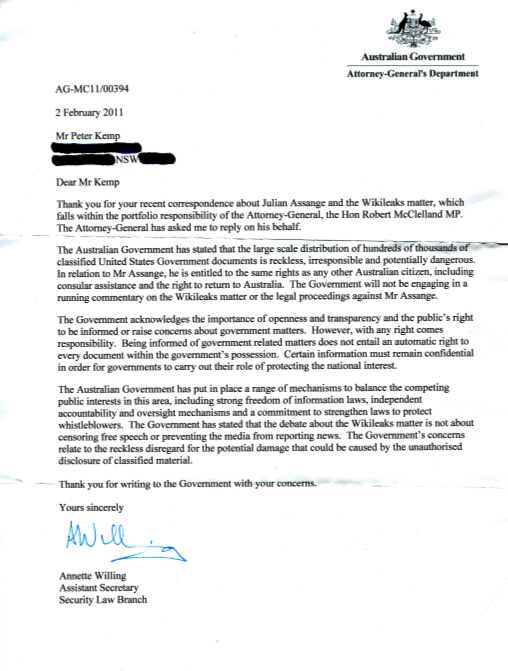
The Australian attorney general's response to an open letter to the Australian Prime Minister Julia Gillard re Julian Assange
From the Guardian's timeline, rewritten for chronology and with legal terminology:
The hearing opened with Clare Montgomery QC, for the Crown Prosecution Service on behalf of the Swedish authorities. Opening submissions are that the Swedish prosecutor, Marianne Ny, is asserted to be an issuing authority for the purposes of a European Arrest Warrant (EAW).
In relation to the offences, the court decides that the alleged victims are to be called Woman A (three counts of sexual assault alleged) and Woman B (one count of r*pe alleged)
Ms Montgomery says the matters are extraditable offences because the definitions in the two countries are the same. "Mr Assange had sexual intercourse with her and exploited the fact that she was asleep." This is submitted to be an offence under English law. In relation to Woman A there are three counts of sexual assault "without consent" and again contrary to English law.
Julian Assange appears tomorrow, 7 February, at Westminster Magistrates Court for what has been announced as a two-day hearing, but judging from past extradition hearings in the UK, it is likely (with appeals) to take much longer, even a year or more, with the second-last word being that of the Supreme Court (formerly House of Lords) and then, under certain circumstances, the last word from the Home Secretary.
Readers should note that the procedure is not to judge the actual case on its merits as a criminal procedure but to judge it according to relevant sections of the UK Extradition Act. Such evidence of the alleged offences that has surfaced is only relevant indirectly, such as to prosecutorial abuses, not to the arguable merits of that evidence and a future case in Sweden if extradition occurs.
The Skeleton Argumentbegins with a challenge to prosecutor Ms Ny’s authority to issue an European Arrest Warrant (EAW). The case of Enander v. The Swedish National Police Board [2005] EWHC 3036 (Admin) is cited; it states that only the Swedish National Police Board is the authorised authority.
Context
Julian Assange was placed in international proceedings based on a European Arrest Warrant issued by Swedish prosecutors. European Union (EU) countries have a treaty that facilitates the process of a speedy extradition from one EU country to another, and beginning on Monday, February 7, a two-day hearing at Belmarsh Woolwich Crown Court in south London will determine whether Assange will be extradited from the UK to Sweden to face sex-crime accusations. He has been accused but has not been charged.
If Assange should lose, he will be extradited to Sweden unless he appeals the decision and wins. If he appeals, the appeal would be made to the Administrative Court, but it could be several months before it is heard. If that appeal is lost, an appeal to the Supreme Court is possible but not guaranteed. If a second appeal to the Supreme Court were to be made and lost, there is a third possibility, an appeal to the European Court of Human Rights in Strasbourg. Again, the possibility of a third appeal is not guaranteed.
Extradition from Sweden to US
Whatever happens in Sweden once Assange is extradited (on the hypothetical assumption that he will be), the US may indict him and have him "temporarily transferred," with Sweden's consent, so that he may face prosecution in the US. This can be done, legally, either before or after Assange undergoes trial in Sweden, according to the US/Sweden extradition treaty supplement (pdf) .
We owe a huge debt of gratitude to Wikileaks, not only for the exposure of the lies and deceptions of various world powers, not just for exposure of the inner workings and chicanery of state institutions and corporations, their hypocrisy and double dealings, but also for what follows in future: the advancement of human rights for all, and a major corollary of that, the increased potential for prosecution of those who have prima facie cases to answer for breaches of human rights.
Firstly some analogies with theoretical physics.
For theoretical physicists like Lawrence Krauss, (whose understandable scientific explanations of the universe leave this writer in awe), supernova are useful as standard candles …for which the intrinsic brightness, the absolute magnitude, is known. This allows the object's distance to be measured from its actual observed brightness, or apparent magnitude. With distance and the amount of spectrum “redshift” the expansion of the universe can be measured, and its present acceleration.
If I may draw an analogy, for those concerned about human rights, Wikileaks is akin to a supernova, it is our “standard candle,” so to speak. Not only is it an additional and great illumination for breaches of our measurable “universal” human rights but it has created a new standard for real journalism and in so doing has motivated the world in moral and legal outrage to a significantly higher plane. It has struck a chord with so many, in so many dimensions all over the world. It is difficult to quantify those dimensions, but the human rights aspect of it is not only real but palpable.
It is not clear from the UK Press Association report why Swedish Prime Minister Fredrik Reinfeldt responded to reporters' questions about Julian Assange in London two days ago by addressing the hypothetical question of Assange's extradition from Sweden to the US, but he didn't dismiss it as hypothetical:
Mr Reinfeldt said Sweden's policy was not to extradite people to countries with the death penalty. But he said Sweden's courts, not its government, would decide that. ...
"We should remember when we ask questions about this that these are legal systems talking to each other, not politicians."
We know from the cables and other sources (see the summary in section 7, 92-96, of the "skeleton" legal argument) that Swedish courts have in the past been complicit in the illegal kidnapping of refugee claimants by US agents. More broadly, the role of diplomacy as mediator between law and politics has arisen repeatedly in many of the cables released by its major media partners and WikiLeaks.
Since the role of the courts is usually to interpret legislation ("policy") or to strike it down if it is unconstitutional, Reinfeldt's apparent failure to affirm Swedish refusal to extradite to countries that retain capital punishment raises questions.
Via @calixte on Twitter
We are indebted to Julian Assange who apparently instructed his counsel to make available the "Skeleton Argument" for the extradition hearing proper.
It was expected, per my previous post Extradition Part 3 that the issue of extradition (and arrest) for the purposes of investigation only, would be a highly significant issue for the extradition arguments, and so it was.
One part of that document however that shocked me, that I have discussed with colleagues (likewise shocked) was paragraph 88, the legal implications of which I was unaware. It now seems that some (or indeed all?) of the prospective charges of a sexual nature in Sweden do not have as a required element that the prosecution must prove (for a conviction to be sustained) the element of mens rea, the "guilty mind" otherwise known as the fault element.
Last Monday at 16.30, I was on the internet, trying to help some people find their way around London to be able to go to Belmarsh court. And then it suddenly dawned on me that, after having followed Wikileaks intensely over the last couple of weeks, it would be a good thing to go as well. This is a short account of my experiences - together with practical ideas about the next court-hearing on the 7th and 8th of February.
How to get there:
Travel to Bank-underground station
Take the "light rail train" to Woolwich-Arsenal from there
A short walk away from the trainstation is a busstop - take bus 244/380
The journey took me 1 1/2 hour.
I had mailed the court in advance gl-horseferry.court@hmcourts-service.gsi.gov.uk to ask if there was anything I should be aware of. And this was their reply:
Please see link, the hearing is at 10am, there will be a public gallery, but please get there early. http://www.hmcourts-service.gov.uk/HMCSCourtFinder/SearchLinked.do?court...
So I did - I planned to be there at 8.00 and the whole place was already full of press, vehicles, cameras etc. They were all huddled up behind some type of railing & I was told to go to the front-door of the court and start a queue there. Before I did I had a bit of a chat with whoever was interested. The most intriguing conversation was with a journalist from Expressen: the Swedish paper that broke the news on the rape charges. I said to her that they would know who would have told them the news (see this link http://radsoft.net/news/20101202,00.shtml I don't like the tone of the article, but I love the logic!) & she was like "but we keep our sources confidential". And I was like - "but you must know the full story, would a rape victim have gone to you to advertise??" Funniest was that another journalist joined me and she became more and more agitated.

Jacob Appelbaum is a security analyst who works on Tor and Wikileaks, and has been very instrumental in discovering weaknesses in the Haystack system, among other things. He has gained notoriety with the US government through acting as a speaker and advocate of Wikileaks, and became widely known last fall after a Rolling Stone article calling him "The Most Dangerous Man in Cyberspace" and "The American hacker behind Wikileaks". Recently he was one of the subjects of a subpoena from the US DoJ requesting information from Twitter.
While the Twitter story broke he was in Iceland, and he returned to the US on Monday. He has been the subject of repeated harassment at airports this year, and apparently Monday was no exception, despite members of the ACLU meeting him at the airport. He will be headed to Toronto this weekend and will be able to experience the independence (or not) of Canadian customs.
His tweets on his most recent experience arriving in the US:

This work is licensed under a Creative Commons Attribution-NonCommercial-NoDerivs 3.0 Unported License.
Theme by Danetsoft and Danang Probo Sayekti inspired by Maksimer


